
Nine billion possibilities. One petabyte of data. And you can search it for free starting today.
Google DeepMind launched AlphaGenome Atlas on Tuesday, a platform that predicts the molecular effects of every possible single-letter change in human DNA. All nine billion of them.
The company calls it “the most comprehensive catalogue of how genetic mutations affect molecular biology” ever created.
Here’s why that matters.
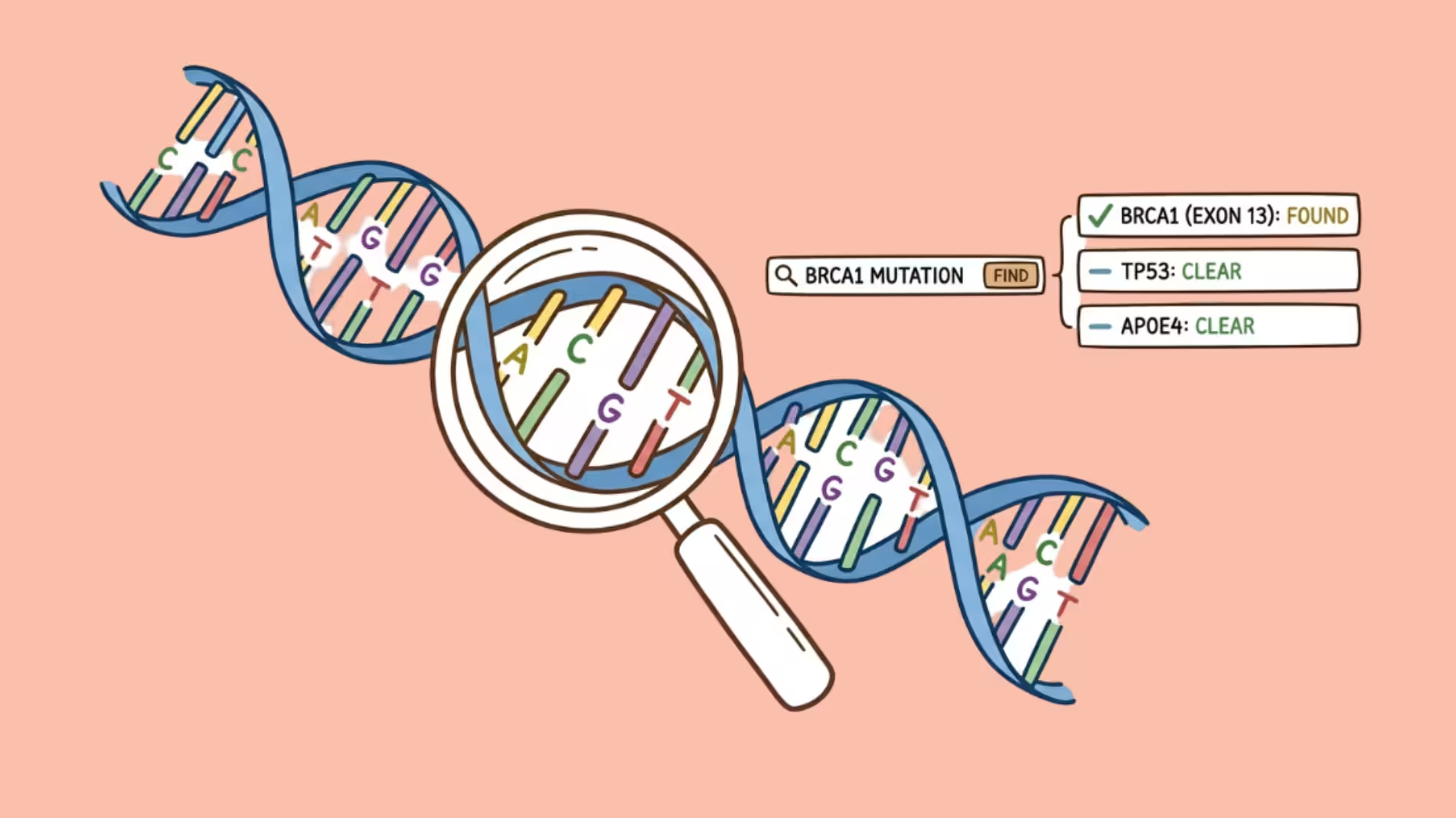
Human DNA is written in four chemical letters: A, C, G, and T. The human genome contains roughly three billion letter pairs. Any single letter can be swapped for one of three others.
That gives you about nine billion possible changes.
Some of those changes are harmless. Some explain ordinary differences between people. Some cause disease.
The problem? Until now, figuring out which changes actually matter has been agonizingly slow.
Testing all nine billion in a lab is impossible. Atlas does it computationally.
How Atlas Works
Atlas is built on AlphaGenome, a deep learning model DeepMind unveiled last year and published in Nature in January 2026.
AlphaGenome can take a stretch of DNA up to one million base pairs long, compare the original sequence with an altered version, and predict how the change might affect gene expression, RNA splicing, protein production, and other molecular processes.
What’s new with Atlas isn’t the model.
It’s the scale and the accessibility.
Instead of making researchers run the model themselves one variant at a time, DeepMind pre-computed the predictions for every possible single-letter change and packaged the results into a searchable platform at alphagenome.google/atlas.
No coding required. No GPU cluster needed.
“Basically it took us some time to really precompute and also analyze this many variants because the space is so big,” genomics lead Ziga Avsec said during a press briefing.
The resulting dataset is roughly one petabyte, more than 30 times larger than the AlphaFold Database.
The Variant Impact Score Changes the Workflow
Knowing what nine billion mutations could do is only useful if you can find the ones that matter.
That’s where the AlphaGenome Variant Impact (AVI) score comes in.
It aggregates predictions across both the 2% of the genome that codes for proteins and the other 98% that regulates gene behavior into a single ranking metric.
Researchers can now type in a gene or a region, see every possible mutation ranked by predicted impact, and drill into the molecular details.
DeepMind says the AVI score works across coding and non-coding regions alike, which matters because most disease-linked variants sit in the non-coding 98% that scientists understand the least.
Early beta testers from the Broad Institute’s GREGoR Consortium used AVI scores to re-examine unsolved rare genetic disorder cases.
The idea: take patients whose conditions have resisted diagnosis, rank the variants in their genomes by AVI score, and see if anything jumps out that previous methods missed.
Why 98% of Your DNA Has Been a Mystery
This is worth pausing on.
Scientists understand the roughly 2% of the human genome that directly codes for proteins relatively well.
The other 98%, often misleadingly called “junk DNA,” actually plays a critical role in regulating how, when, and where genes are turned on and off.
But interpreting that regulatory landscape at a molecular level has been one of biology’s hardest problems.
DeepMind’s earlier tool AlphaMissense focused specifically on predicting which mutations might alter proteins.
Atlas extends far beyond proteins, covering the regulatory regions that control gene behavior. That extension is what makes this genuinely new.
“AlphaMissense looks at proteins,” Avsec told Fortune. “With AlphaGenome, we are focusing on the regulatory part of the genome.”
What It Can’t Do
Atlas predicts molecular effects. It does not diagnose diseases. The researchers are clear about this.
The technical paper explicitly states that Atlas and AVI scores “can serve only as part of the evidence chain leading to clinical diagnoses, not as sufficient evidence on their own.”
There are also real technical limitations.
Many diseases involve multiple genetic variants interacting together.
AlphaGenome’s window is one million base pairs, but some regulatory DNA sequences called enhancers can control genes from much further away, beyond the model’s reach.
And the model was trained on a reference genome, meaning it may not capture variation across diverse human populations equally well.
Still, for a field where progress has been bottlenecked by the sheer impossibility of testing every variant experimentally, having pre-computed predictions for all nine billion is a step change.
The AlphaFold Playbook, Applied to DNA
The strategy is familiar.
With AlphaFold, DeepMind solved a 50-year-old problem in protein structure prediction, released the data freely, and watched it become embedded in pharmaceutical research worldwide.
AlphaFold earned Demis Hassabis and John Jumper the 2024 Nobel Prize in Chemistry. (Jumper has since left DeepMind for Anthropic.)
Atlas follows the same playbook. Build the model. Pre-compute the data. Release it free for academic research. Let it become indispensable. Then offer commercial access on Google Cloud.
The timing is also notable.
Hassabis recently stepped back from running DeepMind day-to-day to focus on scientific research and lead drug-discovery spinoff Isomorphic Labs.
Atlas is the kind of foundational science tool that fits that mission perfectly.
Atlas is available for noncommercial use through its website starting today.
Scientists can also access it through the AlphaGenome API and as a skill in Google’s agentic development platform Antigravity.
Commercial access on Google Cloud is coming soon.
