

The AI agent framework landscape in 2026 has a paradox: too many good options.
Gartner predicts that 40% of enterprise applications will feature task-specific AI agents by end of 2026, up from less than 5% in 2025. The frameworks are ready. The confusion is picking the right one.
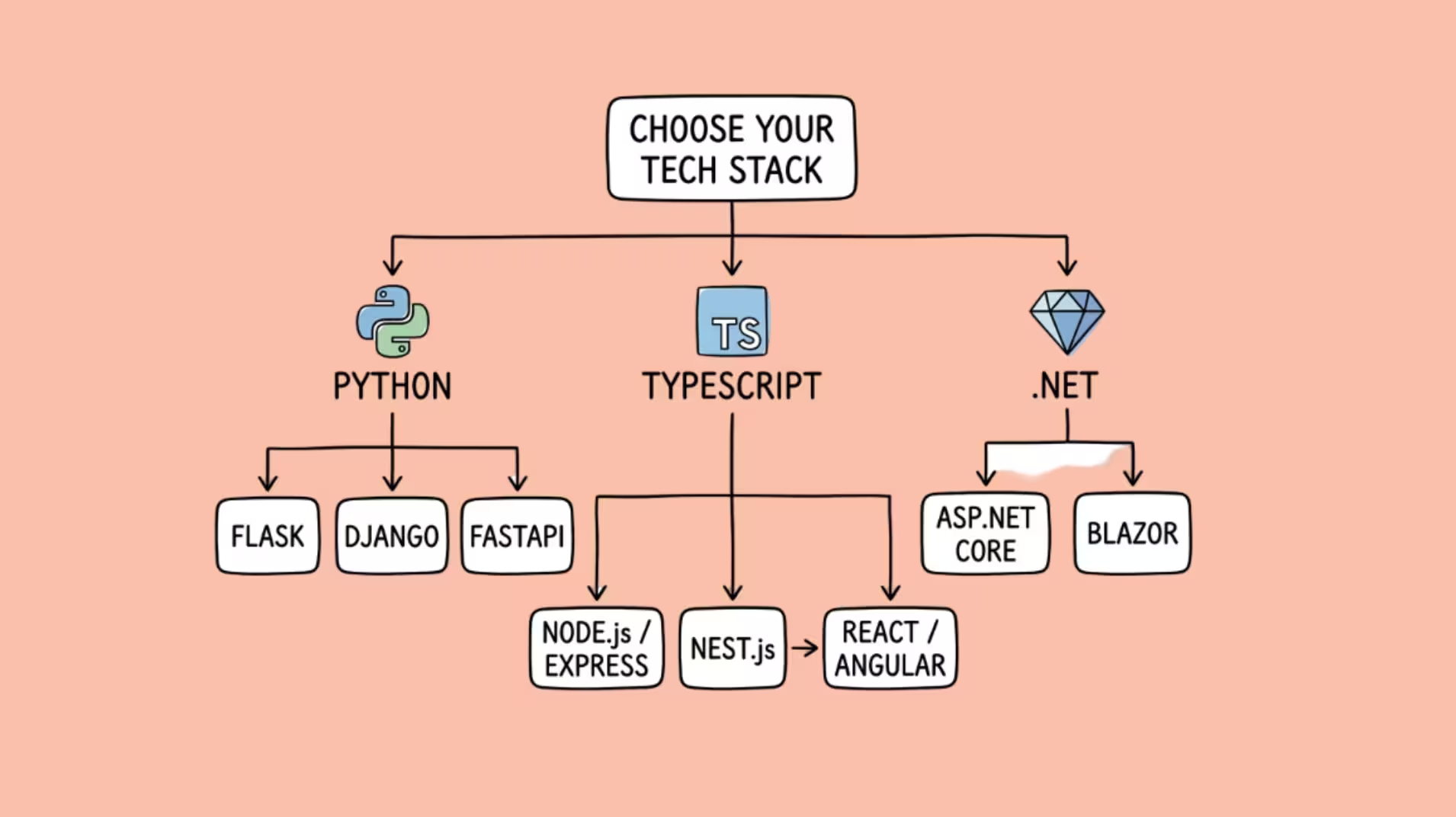
After shipping production agents with four of these frameworks and evaluating all eleven, here is the decision that actually matters: start from your language and your orchestration needs, not from feature lists.
The TypeScript question is Mastra vs Vercel AI SDK.
The Python question is LangGraph vs OpenAI Agents SDK vs CrewAI.
The .NET question is Microsoft Agent Framework. Everything else follows.
| Framework | Language | Best for | Model-agnostic? | Multi-agent? | Learning curve | Production readiness |
| LangGraph | Python | Complex stateful workflows | Yes | Yes (graph-based) | Medium | Highest |
| LangChain | Python/JS | Rapid prototyping, LLM app foundation | Yes | Via LangGraph | Low-medium | High |
| CrewAI | Python | Fast multi-agent prototypes | Yes | Yes (role-based crews) | Lowest | Medium |
| OpenAI Agents SDK | Python | Clean single-agent loops on OpenAI | No (OpenAI only) | Yes (handoffs) | Low | High |
| Claude Agent SDK | Python | Safety-first agents with extended thinking | No (Claude only) | Yes (sub-agents) | Medium | High |
| Google ADK | Python | Gemini/Vertex AI agents | Optimized for Gemini | Yes (hierarchical) | Medium | Early-medium |
| Mastra | TypeScript | TS-first agent products | Yes | Yes | Medium | Medium-high |
| AutoGen (AG2) | Python | Multi-agent debate and collaboration | Yes | Yes (GroupChat) | Medium | Medium (maturing) |
| Microsoft Agent Framework | C#/Python | Enterprise .NET agent systems | Yes | Yes (graph-based) | Medium-high | High |
| LlamaIndex | Python/TS | Knowledge-heavy RAG agents | Yes | Via workflows | Medium | High |
| Haystack | Python | Document processing pipelines | Yes | Via pipelines | Medium | High |
1. LangGraph
Best for Complex Production Workflows
LangGraph treats agent steps as nodes in a directed graph. You define states, transitions, and conditional logic explicitly.
The agent moves through the graph, and you can see (and control) exactly where it is at every step.
With 34.5 million monthly downloads, LangGraph leads enterprise adoption by a wide margin.
The production features justify that dominance: built-in checkpointing (save and restore agent state at any point), time-travel debugging (replay from any checkpoint), per-node token streaming, and human-in-the-loop approval steps.
In my experience across 3 LangGraph deployments, the graph model pays for itself on complex workflows where you need explicit control over branching logic.
A customer support agent that routes differently based on sentiment, ticket type, and customer tier is easy to reason about as a graph. It is a nightmare as a freeform prompt loop.
The trade-off: LangGraph requires more upfront design than frameworks that let you “just start prompting.” That design cost is the point.
Best for: Teams building complex, stateful, multi-step agent workflows that need production-grade observability.
2. LangChain
Best Foundation Layer for LLM Applications
LangChain is the abstraction layer that connects LLMs to tools, memory, and data sources.
It is not an agent framework in the strict sense. It is the plumbing that most Python agent frameworks (including LangGraph) build on top of.
LangChain handles the common tasks: prompt templates, model switching, output parsing, document loading, vector store integration, and chain composition.
If you are building any LLM application in Python, LangChain components are probably involved somewhere in your stack even if you are using a different orchestration layer.
The honest take: LangChain’s early reputation for abstraction bloat was earned. The framework tried to do too much and wrapped everything in unnecessary layers.
The 2025-2026 refactoring improved this significantly, and LangGraph now handles the orchestration that LangChain used to attempt on its own.
Best for: Foundation layer for any Python LLM application. Use LangGraph on top for agent orchestration.
3. CrewAI
Best for Fast Multi-Agent Prototyping
CrewAI uses a role-based mental model: you define agents with personas, give each one tools and a task, and organize them into a “crew” with a process type (sequential, hierarchical, or consensual).
A working multi-agent prototype runs in roughly 20 lines of code.
That speed of initial setup is CrewAI’s genuine advantage.
For hackathons, proof-of-concepts, and demos where you need a multi-agent system running in an afternoon, nothing else gets you there faster.
The abstractions map to how non-technical stakeholders think about teams: “the researcher finds information, the writer drafts the report, the editor reviews it.”
The limitation I hit on a client project: CrewAI’s simplicity becomes a constraint at production scale. Limited checkpointing, less granular state management than LangGraph, and debugging multi-agent interactions requires more manual instrumentation.
I started one project in CrewAI for speed and migrated to LangGraph when the workflow complexity outgrew CrewAI’s abstractions. That migration cost 2 weeks. Starting in LangGraph would have cost 1 extra week upfront but saved the migration entirely.
Best for: Fast prototyping, demos, and multi-agent systems that stay relatively simple.
4. OpenAI Agents SDK
Best Clean API for OpenAI-Locked Teams
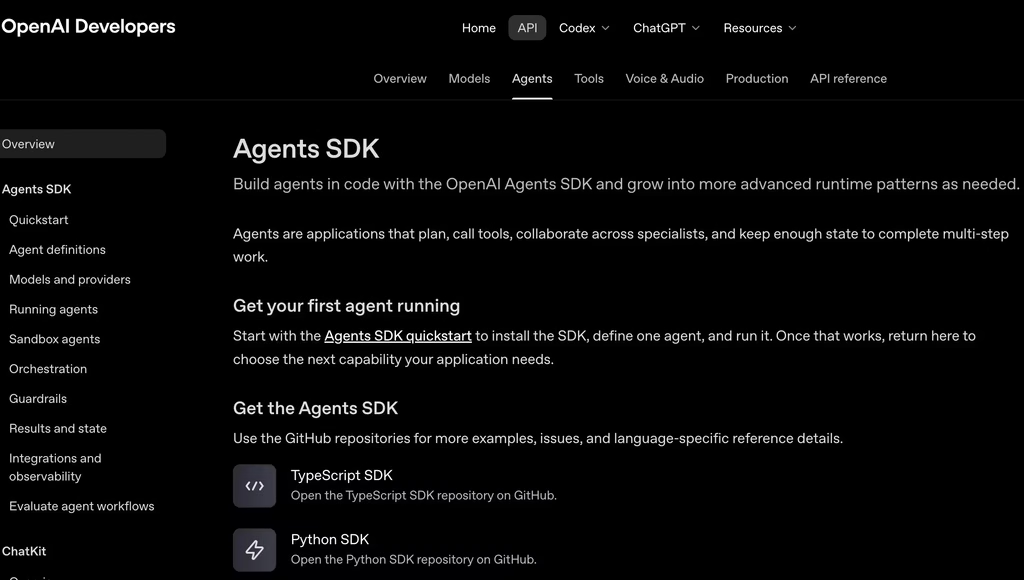
The OpenAI Agents SDK provides a minimal, opinionated API for building agents on OpenAI models.
Built-in tracing, guardrails, and explicit handoff patterns (one agent passes control to another) make it production-ready out of the box.
The API design is the cleanest of any framework on this list.
If your team already commits to OpenAI models and wants the fastest path to a working agent with good observability, this SDK removes friction that framework-agnostic tools add.
The tracing is especially strong: every tool call, model response, and handoff is logged automatically.
The obvious constraint: OpenAI models only. If model flexibility matters to your roadmap (and in 2026, it should), this lock-in is a real cost.
Best for: Teams committed to OpenAI models who want minimal framework overhead with built-in observability.
5. Claude Agent SDK
Best for Safety-First Agent Development
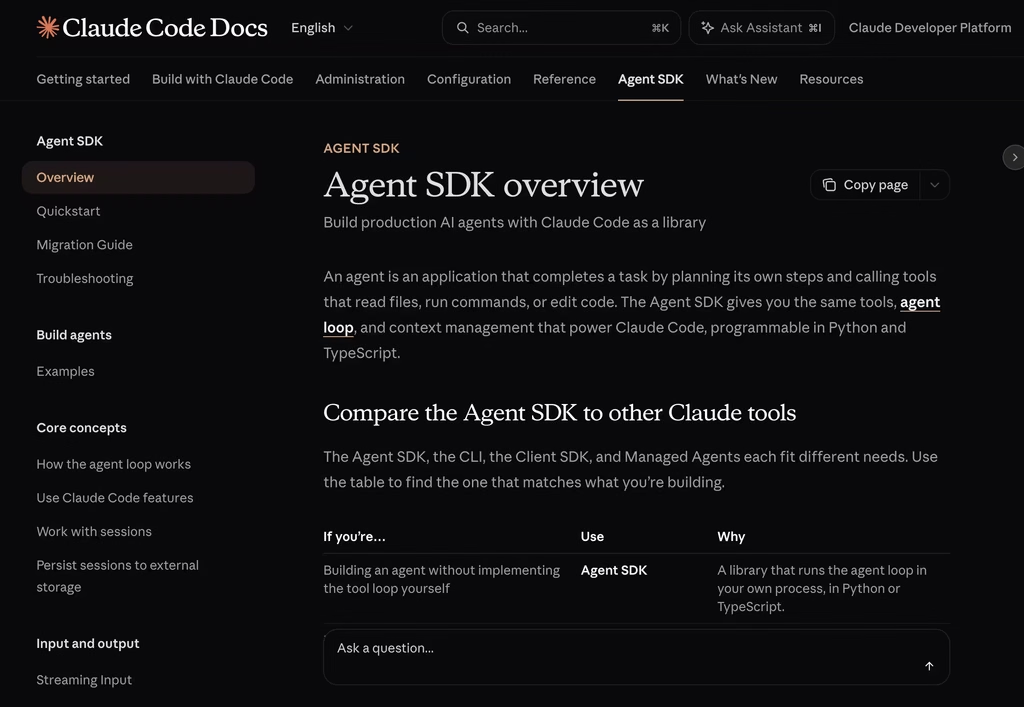
The Claude Agent SDK integrates extended thinking (the model reasons step-by-step before acting), MCP-native tool connections, and sub-agent delegation into a safety-first development experience.
Every tool call includes an approval mechanism. The default posture is cautious.
For agents operating in high-stakes environments (healthcare, finance, legal, compliance) where a wrong action has real consequences, Claude’s safety-first architecture is a feature, not a limitation.
The extended thinking traces show you exactly why the agent chose a particular action before it executes.
The constraint mirrors the OpenAI SDK: Claude models only. The MCP integration is the tightest of any framework (unsurprisingly, since Anthropic created MCP), which matters if your tool ecosystem is MCP-based.
Best for: High-stakes agent deployments where safety, auditability, and reasoning transparency are requirements.
6. Google ADK
Best for Gemini and Vertex AI Teams
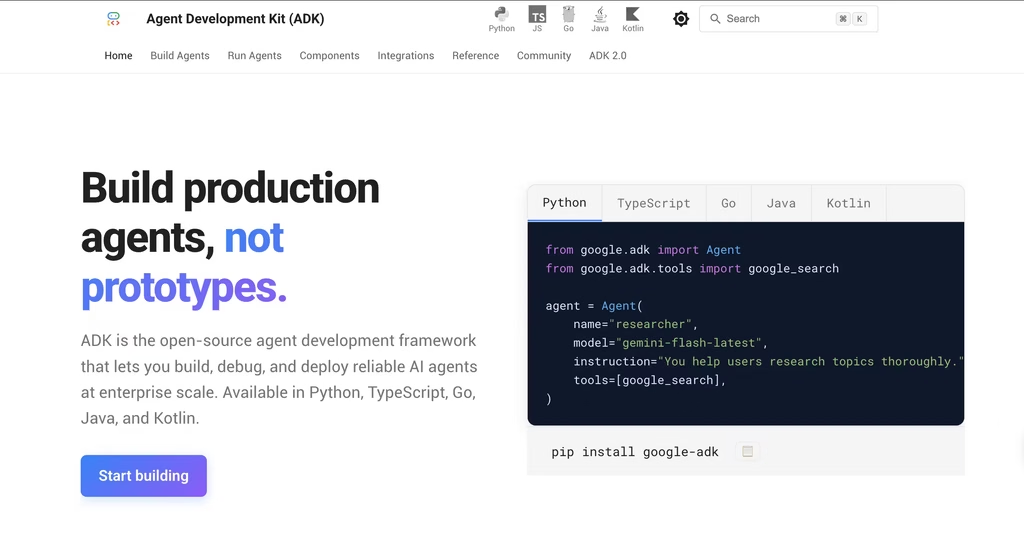
Google ADK (Agent Development Kit) provides hierarchical agent orchestration optimized for Gemini models and Vertex AI deployment.
Parent agents delegate to child agents in a tree structure, with session state managed through pluggable backends.
ADK is the newest major framework (2025), which means the ecosystem of community extensions and third-party integrations is smaller than LangGraph or CrewAI.
Google’s backing and Vertex AI integration make it a strong choice for GCP-native teams, but evaluate carefully if your stack is not Google-centric.
Best for: Teams on Google Cloud building agents with Gemini models and Vertex AI infrastructure.
7. Mastra
Best TypeScript-First Agent Framework
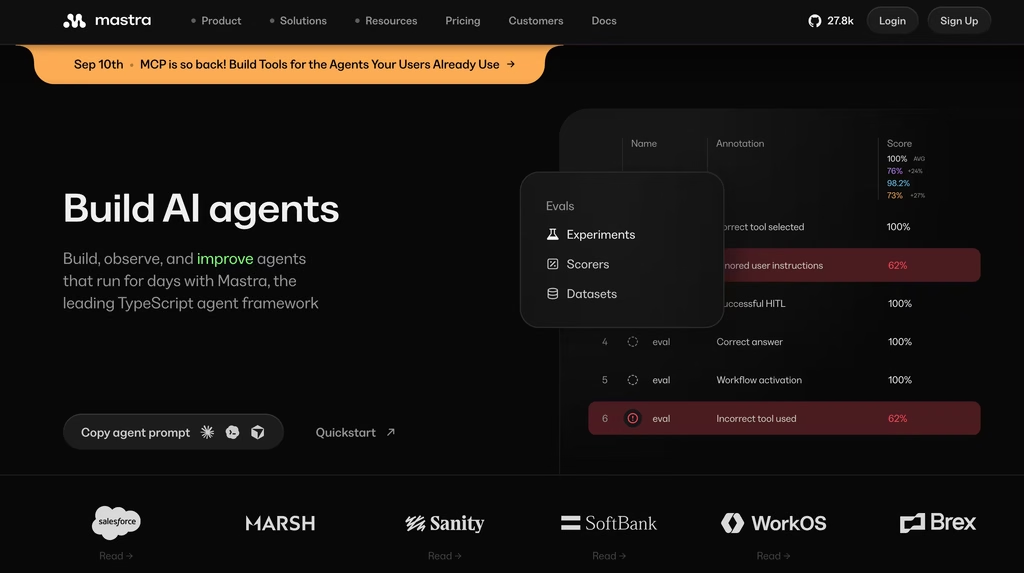
Mastra is the answer for TypeScript teams who do not want to context-switch to Python for agent development.
It provides workflows, tool integration, RAG, memory, and cloud deployment in a TypeScript-native package with modern developer experience.
For teams building agent-powered products (SaaS features, customer-facing bots, internal tools) where the rest of the codebase is TypeScript/Next.js, Mastra keeps the entire stack in one language.
The cloud deployment story is more mature than most Python frameworks, where deployment often means “figure out Docker yourself.”
The ecosystem is younger than LangGraph or CrewAI. Community plugins, examples, and Stack Overflow answers are growing but not yet at the depth of the Python frameworks.
Best for: TypeScript teams building agent-powered products who want a modern, well-designed framework.
8. AutoGen (AG2)
Best for Multi-Agent Conversation and Debate
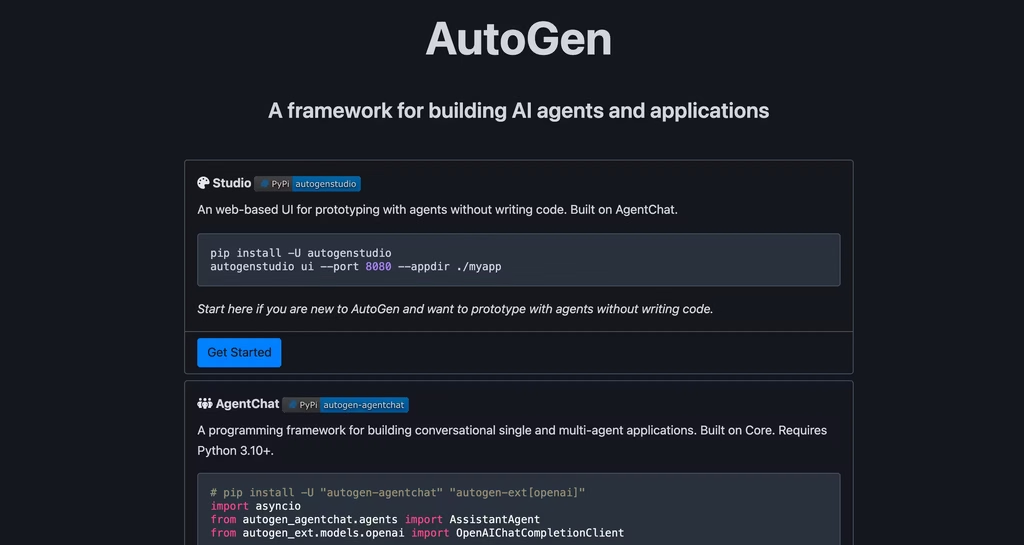
AutoGen, rebuilt as AG2, pioneered the GroupChat pattern: multiple agents share a conversation space and a selector determines who speaks next.
This is the most natural fit for scenarios where agents need to debate, negotiate, or collaboratively reason through a problem.
The 2025-2026 rearchitecture rebuilt AutoGen with an event-driven core, async-first execution, and pluggable orchestration.
The rewrite was necessary but created fragmentation: tutorials, blog posts, and Stack Overflow answers from the pre-AG2 era no longer apply, and the community is still rebuilding around the new API.
If you are a Microsoft-stack enterprise, evaluate Microsoft Agent Framework (which inherits AutoGen’s ideas) instead.
AG2 is best for teams that specifically want the conversational multi-agent pattern and are comfortable with a framework still stabilizing after a major rewrite.
Best for: Multi-agent debate, negotiation, and collaborative reasoning scenarios.
9. Microsoft Agent Framework
Best for Enterprise .NET Teams
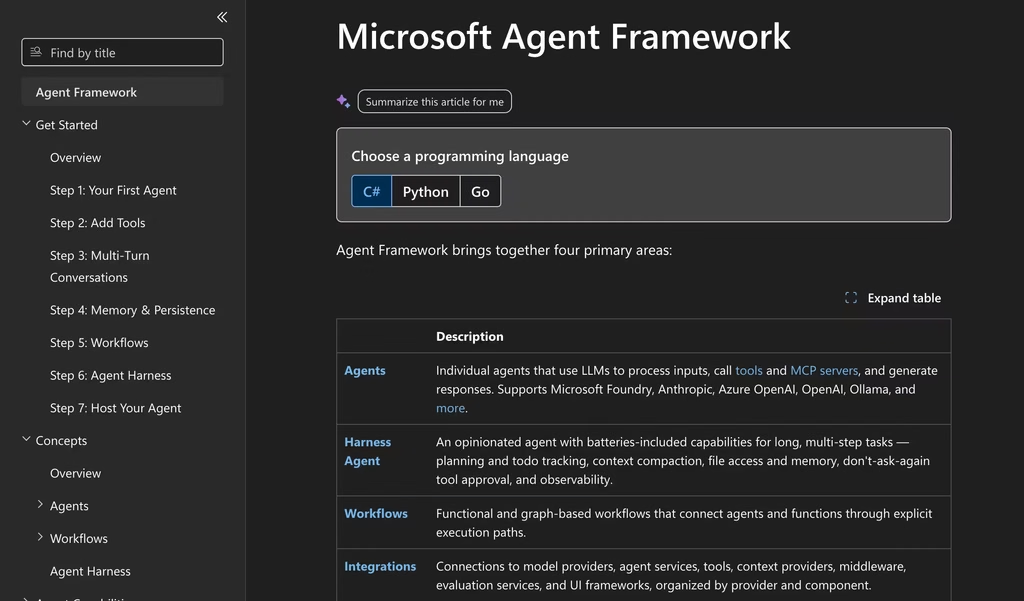
Microsoft Agent Framework (April 2026) combines AutoGen’s simple agent abstractions with Semantic Kernel’s enterprise features: session-based state management, type safety, middleware, telemetry, and graph-based workflows for explicit multi-agent orchestration.
For .NET/C# shops building AI agents, this is the default choice.
Semantic Kernel (27,900+ GitHub stars) has been the enterprise AI framework for Microsoft ecosystems since before the agent era, and Agent Framework extends it with agent-specific patterns.
The consideration: this is enterprise software through and through. If you are a solo developer or small team building quickly, the setup overhead will slow you down compared to CrewAI or Mastra.
The framework is built for teams that have architects, code reviews, and deployment pipelines.
Best for: Enterprise teams on the Microsoft stack, especially .NET/C# shops with existing Semantic Kernel investment.
10. LlamaIndex
Best for Knowledge-Heavy RAG Agents
LlamaIndex started as a RAG (Retrieval-Augmented Generation) framework and evolved into an agent platform.
Its strength remains document-heavy workloads: ingesting large document collections, chunking, embedding, indexing, and retrieving relevant context for agent tasks.
If your agent’s primary job is answering questions from a large knowledge base (internal docs, legal archives, financial reports, medical literature), LlamaIndex’s pipeline architecture handles the data plumbing more naturally than frameworks that bolted RAG on as an afterthought.
Best for: Agents that primarily work with large document collections and knowledge bases.
11. Haystack
Best for Document Processing Pipelines
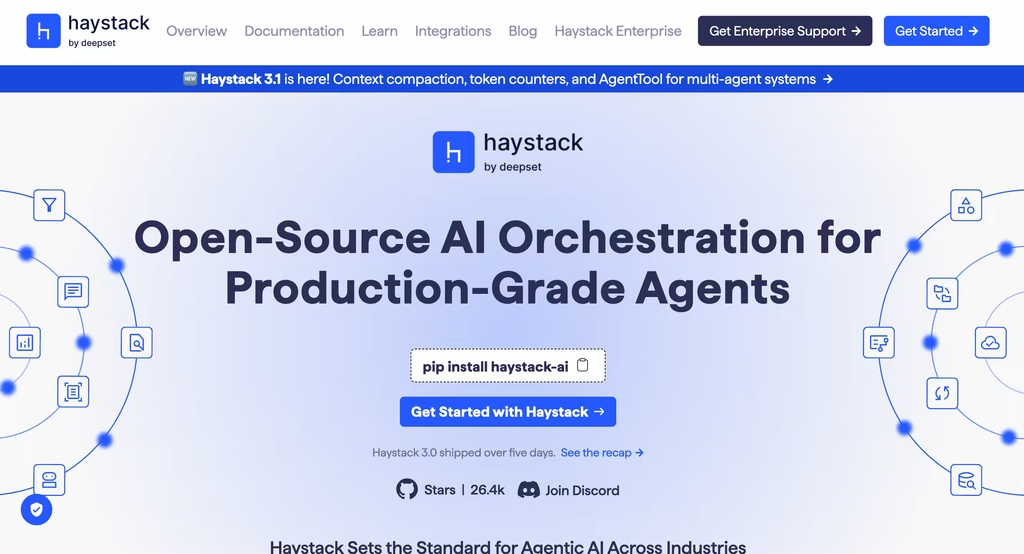
Haystack (by deepset) is a provider-agnostic pipeline framework where every component (reader, retriever, generator, ranker) is a modular, swappable node.
The pipeline architecture treats document processing as a first-class operation rather than a bolt-on feature.
For teams building search-powered agents, question-answering systems, or document intelligence pipelines, Haystack provides the most explicit control over each processing step.
It is less opinionated about agent orchestration than LangGraph or CrewAI, which means more flexibility but more design decisions.
Best for: Search-powered agents and document intelligence pipelines where processing control matters.
How to Pick the Right Framework
| Your situation | Start here |
| Python team, complex multi-step workflows, production requirements | LangGraph |
| Python team, need a working multi-agent prototype by Friday | CrewAI |
| TypeScript team building an agent-powered product | Mastra |
| Committed to OpenAI models, want minimal framework overhead | OpenAI Agents SDK |
| High-stakes environment (healthcare, finance, legal) | Claude Agent SDK |
| Google Cloud / Gemini-native team | Google ADK |
| .NET/C# enterprise with existing Microsoft infrastructure | Microsoft Agent Framework |
| Agent primarily processes large document collections | LlamaIndex or Haystack |
| Need agents that debate and collaboratively reason | AutoGen (AG2) |
| Just getting started, unsure what you need | CrewAI (fastest start) → migrate to LangGraph when complexity grows |
After shipping agents with four of these frameworks, my honest recommendation for most Python teams: start with CrewAI if you need to prove the concept fast, then move to LangGraph when you need production-grade observability, checkpointing, and explicit workflow control.
For TypeScript teams, Mastra is the clear choice.
For enterprise .NET, Microsoft Agent Framework.
And if you are locked to one model provider and happy about it, the vendor SDKs (OpenAI, Claude, Google ADK) provide the tightest integration with the least framework overhead.
The worst decision is spending 3 weeks evaluating frameworks instead of building. Pick the one that matches your language and orchestration needs. Ship something. Migrate later if needed. The frameworks are converging anyway.
FAQs
1) What is the most popular AI agent framework in 2026?
LangGraph, with 34.5 million monthly downloads. It leads enterprise adoption because of its production features (checkpointing, time-travel debugging, human-in-the-loop). CrewAI is the most popular for prototyping due to its low learning curve.
2) Should I use LangChain or LangGraph?
Both. LangChain is the foundation layer (model connections, tools, memory). LangGraph is the orchestration layer (workflow control, state management, multi-agent coordination). Most production LangChain applications use LangGraph for agent logic.
3) Is CrewAI good for production?
For simple multi-agent workflows, yes. For complex workflows requiring checkpointing, granular state management, and detailed observability, LangGraph is more production-ready. Many teams prototype in CrewAI and migrate to LangGraph when complexity increases.
4) Can I use multiple models with one framework?
LangGraph, CrewAI, Haystack, LlamaIndex, AutoGen, and Mastra are fully model-agnostic. OpenAI Agents SDK is locked to OpenAI. Claude Agent SDK is locked to Claude. Google ADK is optimized for Gemini but supports others.
5) Which framework has the lowest learning curve?
CrewAI. The role-based mental model (agents with personas forming a “crew”) is intuitive and a working prototype runs in roughly 20 lines. OpenAI Agents SDK is the second-easiest with its clean, minimal API.
6) What about frameworks not on this list?
Pydantic AI (type-safe Python), Vercel AI SDK (TypeScript for web apps), Smolagents (Hugging Face, simplest single-agent loop), Semantic Kernel (.NET, now part of Microsoft Agent Framework), and Strands Agents (AWS) are all worth evaluating depending on your stack. This list focused on the 11 most adopted and production-tested frameworks as of August 2026.
