


Forty-one days. That’s how long Opus 4.7 lasted before Anthropic replaced it.
The last gap between Opus versions was over two months. This one was barely six weeks – the fastest minor-version cadence Anthropic has ever hit.
The speed may not be a coincidence.
TechCrunch noted that Opus 4.7 got a “chilly reception” from some users who found it disappointing. Opus 4.8 feels like Anthropic’s answer to that feedback – shipped fast, priced the same, and focused on the areas where 4.7 fell short.
So what’s actually different?
The Honesty Thing Is the Headline
Anthropic is leading with honesty, which is an unusual selling point for an AI model. Most companies brag about speed or benchmark scores. Anthropic is bragging that its model is four times less likely to let buggy code pass without flagging it.
That sounds niche, but it matters for anyone using Claude as a coding agent.
Previous models would sometimes confidently claim they’d fixed a problem when they hadn’t.
Opus 4.8 is more likely to say “I’m not sure this works” instead of pretending everything’s fine.
Anthropic’s alignment team said the model “reaches new highs on our measures of prosocial traits like supporting user autonomy and acting in the user’s best interest.” Rates of deceptive behavior dropped below Opus 4.7 levels and landed close to Claude Mythos Preview – Anthropic’s most aligned model to date.
The Benchmarks, Quickly
On SWE-bench Verified, the standard test for AI coding ability, Opus 4.8 scored 88.6%. On the harder SWE-bench Pro, it hit 69.2%. On GDPval-AA, a knowledge work evaluation, it scored 1890 Elo – 121 points above GPT-5.5.
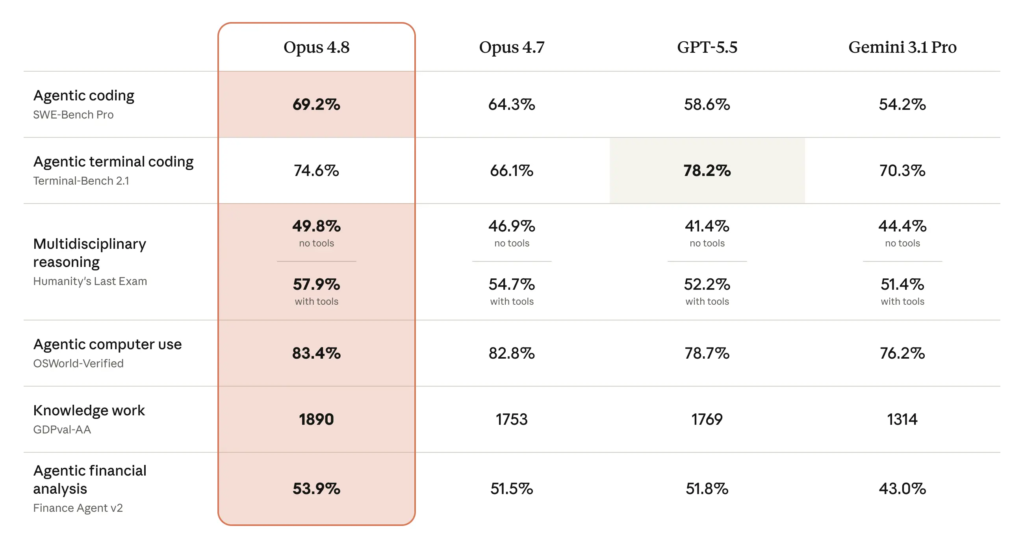
CREDIT: ANTHROPIC
These are solid numbers but not earth-shattering leaps.
Anthropic itself calls Opus 4.8 a “modest but tangible improvement.” That kind of restraint is refreshing in an industry where every release gets marketed as a revolution.
Dynamic Workflows Are the Bigger Deal
Alongside the model itself, Anthropic launched a feature called Dynamic Workflows in Claude Code. This one’s worth paying attention to.
It lets Claude plan a large task, spin up hundreds of parallel subagents, and verify the results before reporting back.
Anthropic’s example: Claude Code with Opus 4.8 can now handle full codebase-scale migrations across hundreds of thousands of lines of code – from kickoff to merge -using the existing test suite as its quality bar.
That’s not a chatbot feature. That’s an engineering tool. Dynamic Workflows is available for Enterprise, Team, and Max plans in Claude Code.
You Can Now Control How Hard Claude Thinks
There’s a new effort slider on claude.ai and Cowork. Want Claude to think deeply and carefully? Crank it up. Need a fast, cheap answer? Turn it down.
Opus 4.8 defaults to “high,” which Anthropic says is the best balance of quality and experience.
For difficult tasks, users can push it to “extra” or “max.” In Claude Code, the equivalent setting is “xhigh.” Lower settings burn through your rate limits slower – a practical tradeoff that gives users real control over cost versus quality.
Fast mode also got a price cut. It’s now three times cheaper than fast mode was on previous Opus models: $10 per million input tokens and $50 per million output tokens.
The $65 Billion Elephant
The launch happened alongside some other news.
Anthropic raised $65 billion in new funding, pushing its valuation to $965 billion – now higher than OpenAI’s. So maybe Opus 4.8 isn’t just a product update. It’s probably a signal to investors and enterprise customers that Anthropic’s release cadence is accelerating.
And then there’s Mythos.
Anthropic confirmed that Mythos-class models – currently restricted to a handful of cybersecurity organizations under Project Glasswing – will come to all customers “in the coming weeks” once safety guardrails are finalized. That’s the release that could really change the competitive picture.
For now, Opus 4.8 is the one you can use today. Same price as before. A bit sharper. A bit more honest about what it doesn’t know. In a market full of hype, that’s a quietly compelling pitch.
