


A weekend rumor sent AI Twitter into a frenzy. Then it turned out to be half true.
It started Saturday night when tech blogger Robert Scoble posted on X claiming Anthropic was acquiring Physical Intelligence, the San Francisco robotics startup behind one of the most widely used robot brain models in the field.
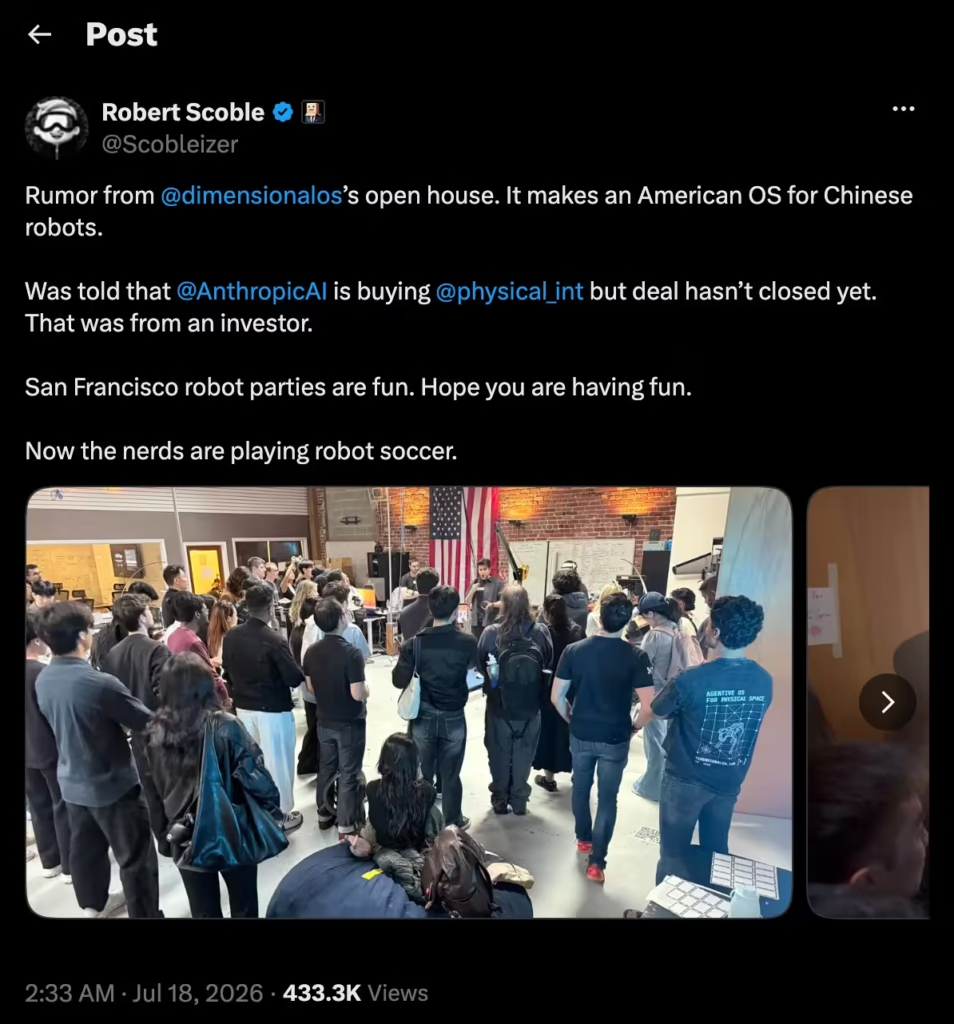
The post spread fast. By Monday morning, everyone in AI had an opinion.
Physical Intelligence CEO Karol Hausman denied it. Sort of.
According to The Information, Hausman told employees the reports weren’t true via a Slack message. The message contained a GIF of a character from The Office shaking her head no.
That’s it. That was the denial.
The Information added the context that made the whole thing stick: Anthropic and Physical Intelligence actually did hold acquisition talks this spring.
Scoble may have gotten the timing wrong. He wasn’t wrong that something happened.
Why Physical Intelligence Matters
This isn’t some garage-stage robotics outfit.
Physical Intelligence was founded in 2024 by a team that reads like an all-star draft of robotics AI: Hausman (former Google Brain robot manipulation lead), Sergey Levine (founding figure of deep reinforcement learning at UC Berkeley), Chelsea Finn (Stanford, author of the landmark MAML meta-learning paper), and Groom (former Stripe employee #30, early angel investor in Figma, Notion, and Ramp).
The company doesn’t build robots. It builds the software brains that make robots work.
Its π-series models are vision-language-action systems that can be plugged into any robotic hardware to enable general-purpose physical tasks.
The latest version uses reinforcement learning tokens that let robots achieve sub-millimeter precision after just 15 minutes of training.
Physical Intelligence has raised over $1 billion across three rounds in under two years and was reportedly seeking another $1 billion at an $11 billion valuation this spring.
Its investor list includes Khosla Ventures, Thrive Capital, Sequoia Capital, Jeff Bezos, and CapitalG.
And OpenAI.
The OpenAI Wrinkle
Here’s where it gets complicated. OpenAI is an investor in Physical Intelligence. It participated in the company’s $70 million seed round in March 2024 alongside Khosla and Sequoia.
That means OpenAI is a stakeholder in a company that its chief rival was reportedly trying to buy.
It raises obvious questions about whether OpenAI’s investment came with information rights, board observer seats, or a right of first refusal over a sale to a competitor.
Those are exactly the kinds of protective provisions strategic investors negotiate for situations like this.
TechCrunch asked OpenAI about it. The company didn’t respond.
If Physical Intelligence is actually in play, OpenAI may have the stronger claim. It’s already a shareholder, already close to Groom, and already building its own robotics lab in San Francisco.
CEO Sam Altman announced “OpenAI Robotics” in late May, describing a near-term focus on infrastructure robots with a personal robot for everyone as the long-term vision.
Why Anthropic Would Want a Robotics Company
Anthropic hasn’t built anything resembling OpenAI’s hardware effort. But it hasn’t ignored the physical world either.
Last November, Anthropic ran Project Fetch, an internal experiment testing how well Claude could help non-experts program a robot dog.
A second phase in June found that a newer model completed the same tasks roughly 20 times faster than the best human-plus-Claude team from the original experiment.
The reasoning behind an acquisition is straightforward. Physical-world understanding may be a prerequisite for truly superintelligent systems. No amount of internet text can substitute for it.
OpenAI learned this the hard way. It built a robotic hand that could solve a Rubik’s Cube, then shut the entire robotics group down in 2021. Co-founder Wojciech Zaremba later said the approach was missing pieces needed for real superintelligence.
Buying Physical Intelligence would let Anthropic skip years of that learning curve. But at $11 billion, it wouldn’t be cheap.
The Acquisition Year That Keeps Escalating
This rumor lands in a year where AI acquisitions have become so frequent they barely register. Anthropic has made four known acquisitions in 2026. OpenAI has been more aggressive, acquiring at least 17 companies since 2023.
Both companies also confidentially filed for IPOs in June, setting up what could be two of the largest U.S. stock debuts in history.
That pre-IPO window is a prime time for acquisitions that round out a company’s story for public investors.
Robotics is the obvious next chapter. Whether Physical Intelligence ends up inside Anthropic, inside OpenAI, or stays independent may depend on investor dynamics more than technology.
But the fact that both frontier labs are circling the same $11 billion robotics startup tells you everything about where AI is headed next.
The GIF denial was funny. The underlying story isn’t a joke.
