


On Friday, OpenAI released a brand-new set of personal finance tools inside ChatGPT. The feature is currently in preview for Pro subscribers in the United States. And it’s a big deal.
We’re talking about a chatbot that can now look at your actual spending, your investment accounts, and your subscriptions, then have a real conversation with you about all of it.
ChatGPT Finance
The tool lets you link your financial accounts directly to ChatGPT. Once connected, you get a dashboard.
It shows your portfolio performance, your monthly spending, your active subscriptions, and any upcoming payments.
You can then ask it questions like: “Have I been spending more than usual lately?” “What do I spend the most on?”
ChatGPT will then look at your data and give you a response tailored to your situation.
Also read: OpenAI Adds a Trusted Contact Feature to ChatGPT After Lawsuits
Bank Connections
OpenAI didn’t build the account-linking piece from scratch. Instead, it partnered with Plaid, a well-known financial data company.
Plaid already connects to over 12,000 financial institutions. That list includes big names like Chase, Fidelity, Schwab, Robinhood, American Express, and Capital One.
So if you bank or invest with any of those, you can plug them into ChatGPT right now. OpenAI also said it plans to add Intuit support soon.
That would open up some really useful capabilities, like seeing how selling a stock might affect your taxes, or checking your odds of getting approved for a new credit card.
Getting Started
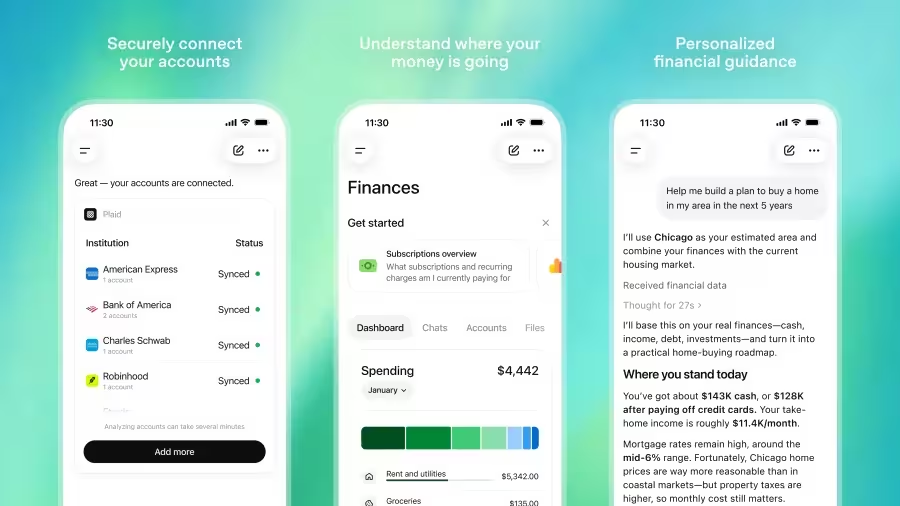
There are two options. First, look for the “Finances” option in your ChatGPT sidebar. Click “Get started.” From there, the chatbot walks you through connecting your accounts via Plaid.
Second, just type “@Finances, connect my accounts” directly into a ChatGPT conversation. It will guide you through the rest.
The tool is available on the web and on iOS. Android support hasn’t been announced yet.
Hiro Acquisition
One month ago, OpenAI quietly bought the team behind Hiro. Hiro was an AI personal finance startup backed by investors including Ribbit, General Catalyst, and Restive.
OpenAI confirmed that Hiro’s team brought finance expertise that helped launch this product. It didn’t say whether the team built the entire feature, but their fingerprints are clearly on it.
That acquisition happened fast, and so did the product launch.
Smarter Model
The timing of this launch lines up with recently introduced GPT-5.5, OpenAI’s latest AI model. According to OpenAI, GPT-5.5 is noticeably better at reasoning through context.
That matters a lot for finance questions, where the right answer often depends on the full picture, not just a single data point.
OpenAI said it also worked with finance experts to build a special benchmark. The goal was to test and improve the model specifically on personal finance questions.
So the model isn’t just smarter in general; it’s been trained to handle money topics well.
Data Privacy
Privacy is a fair concern when you’re sharing bank data with an AI. OpenAI addressed this directly.
You can remove any connected account at any time. Just go to Settings > Apps > Finances. Once you disconnect a service, your synced data gets deleted from ChatGPT within 30 days.
You can also view and delete specific financial memories from the Finances page. So if ChatGPT remembers something you’d rather it forget, you can clear it out.
Why Finance?
More than 200 million people already ask ChatGPT financial questions every month. That tells you that people are already using AI as a money resource, even without specialized tools.
Now AI companies are building products to match that behavior. OpenAI and Anthropic have both launched health-focused tools.
Earlier this month, Perplexity launched its own financial research product built on its Computer agent.
