


Besides consultations, procedures, and tests, healthcare runs on communication. Yet most practices still struggle with missed calls, scheduling backlogs, and overwhelmed front-desk staff. However, EliseAI can fix that.
This New York-based company built its name in property management first. Then it pivoted into healthcare in 2023. Today, it promises to fix the administrative chaos that drains time, money, and patience from both providers and patients.
Does it actually deliver? Below is what the evidence shows, along with clear areas where EliseAI earns its price tag and where it doesn’t.
What Is EliseAI?
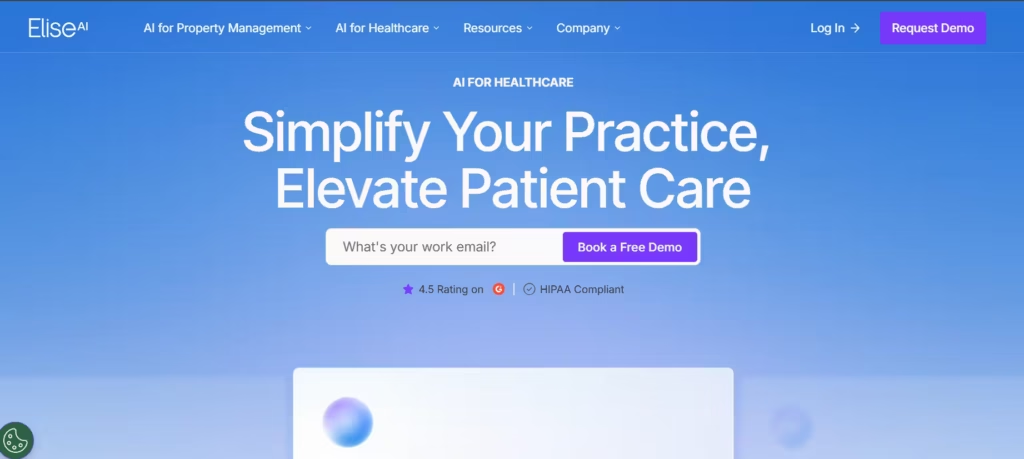
EliseAI is a conversational AI platform. Minna Song and Tony Stoyanov founded the company in 2017 to solve a problem: rental prospects weren’t getting callbacks. That housing fix worked well enough to build a unicorn. Then the founders noticed a familiar pattern in healthcare.
U.S. healthcare administrative costs top $600 billion a year, and most of that waste traces back to manual, repetitive tasks, the same kind of work EliseAI had already automated for landlords. So the company built HealthAI, a version of its platform tuned for medical practices instead of property managers.
How EliseAI Works in Healthcare
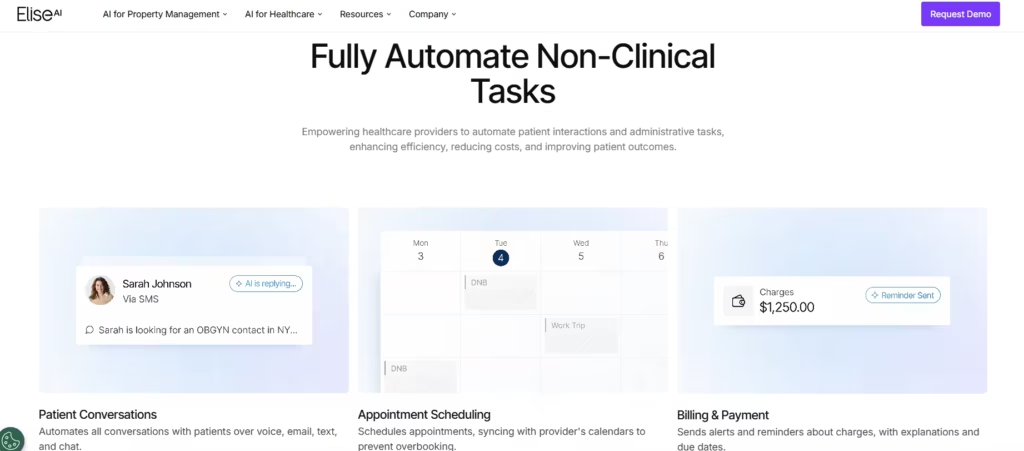
EliseAI holds conversations on phone, text, email, and web chat, with natural language processing to sound less like a phone tree and more like a person. Its VoiceAI feature answers calls, books appointments, and manages follow-ups around the clock. It also integrates with electronic health records through FHIR standards, so scheduling and patient data stay synced without manual entry.
The platform sends billing alerts with plain explanations and due dates, which cuts down on the “why do I owe this?” calls that eat up staff time. EliseAI says it handles 95% of patient inquiries without a human on the line. That number is hard to verify independently, but it’s consistent with what automation platforms in other industries report once they’ve had a few years to train on real call volume, so it’s plausible, even if it shouldn’t be taken as gospel.
EliseAI’s voice agents currently work in roughly 20 languages, including Spanish, Mandarin, and Arabic. For practices in diverse or underserved areas, that’s access improvement.
The Problem EliseAI Aims to Solve
Between 1975 and 2010, the number of U.S. doctors grew by 150%, while the number of healthcare administrators grew by 3,200%. Practices have been hiring their way out of a communication problem for decades, and it hasn’t worked.
CEO Minna Song has pointed out that healthcare and housing together eat up roughly 40% of the average American household’s budget, yet both industries lag badly on technology adoption. Rather than trying to serve every corner of healthcare, EliseAI picked its battles.
It concentrates on outpatient specialties, dermatology, women’s health, ophthalmology, and orthopedics, where labor shortages and call volume hit hardest. A platform trying to be everything to every specialty usually ends up mediocre at all of them.
Benefits of EliseAI
EliseAI claims its platform saves 2 to 3 hours per front-desk employee and cuts overhead by up to 25%. The time savings figure is significant for practices buried in phone volume. But in solo practices and two-provider clinics, the front-desk labor is a small enough line item that a 25% cut won’t move the bottom line much.
The clinical evidence, while limited to company-supplied testimonials, is at least specific. Dr. Pierre Hage of Women’s Health CT, Obstetrics & Gynecology, said EliseAI streamlined his practice’s call center operations, reduced patient wait times, and improved efficiency to the point that the practice is working toward 24/7 coverage without adding headcount. I also found reviews on g2 that detail how much time is saved and the efficiency gains EliseAI has brought on.
On funding, EliseAI raised $250 million in a Series E round led by Andreessen Horowitz and has passed $100 million in annual recurring revenue. A big raise reflects confidence in the market opportunity, but not confirmation that the product works for every practice size; those are two different questions, and it’s worth not conflating them.
Where EliseAI Falls Short
The most significant limitation is scope. EliseAI focuses on non-clinical administrative work. It doesn’t diagnose, triage clinically, or support treatment decisions, so practices looking for clinical AI support need a different tool entirely.
The specialty focus is both the pro and the con. Outpatient dermatology, women’s health, ophthalmology, and orthopedic practices get a platform tuned to their workflows. Primary care, mental health, and other specialties outside that list are likely getting a less mature product, since the company’s own public case studies and specialty claims don’t extend much beyond those four areas.
Practices outside EliseAI’s core focus should ask pointed questions about how much specialty-specific tuning they’re actually getting versus a generic conversational layer. Data privacy is the other question every practice needs to press on directly. FHIR-based EHR integration is a good sign, but HIPAA compliance and data handling specifics should come from EliseAI directly, in writing, before any contract is signed.
Is EliseAI the Right Fit?
Yes, EliseAI is worth serious consideration, but only for a specific type of practice. Outpatient specialty groups in dermatology, women’s health, ophthalmology, or orthopedics, handling high call volume across multiple locations, are the clearest fit. The ROI can be seen in labor savings, EHR integration that removes double data entry, and a platform the company has already tuned for those exact workflows.
Solo practices, low call-volume clinics, or specialties outside EliseAI’s core four should be more cautious. The overhead savings likely won’t be as dramatic, and the platform hasn’t demonstrated the same depth of specialty tuning outside its focus areas. For those practices, a smaller or more general-purpose scheduling tool may deliver similar value at lower cost.
FAQs
1. Which AI tool is best for healthcare?
No single AI tool is best for every healthcare need. For administrative automation, scheduling, billing, call handling, EliseAI is a strong option, particularly for outpatient specialty practices. For clinical decision support or diagnostics, a different, purpose-built platform is a better fit.
2. What is EliseAI built on?
EliseAI runs on a proprietary conversational AI platform combining natural language processing and machine learning. The company uses large language models, including ChatGPT, across its organization, and partners with ElevenLabs to power its voice AI.
3. Who runs EliseAI?
Minna Song serves as CEO and co-founder, and Tony Stoyanov serves as CTO and co-founder. They founded the company in 2017, starting in housing before expanding into healthcare in 2023. EliseAI is headquartered in New York, NY.
