
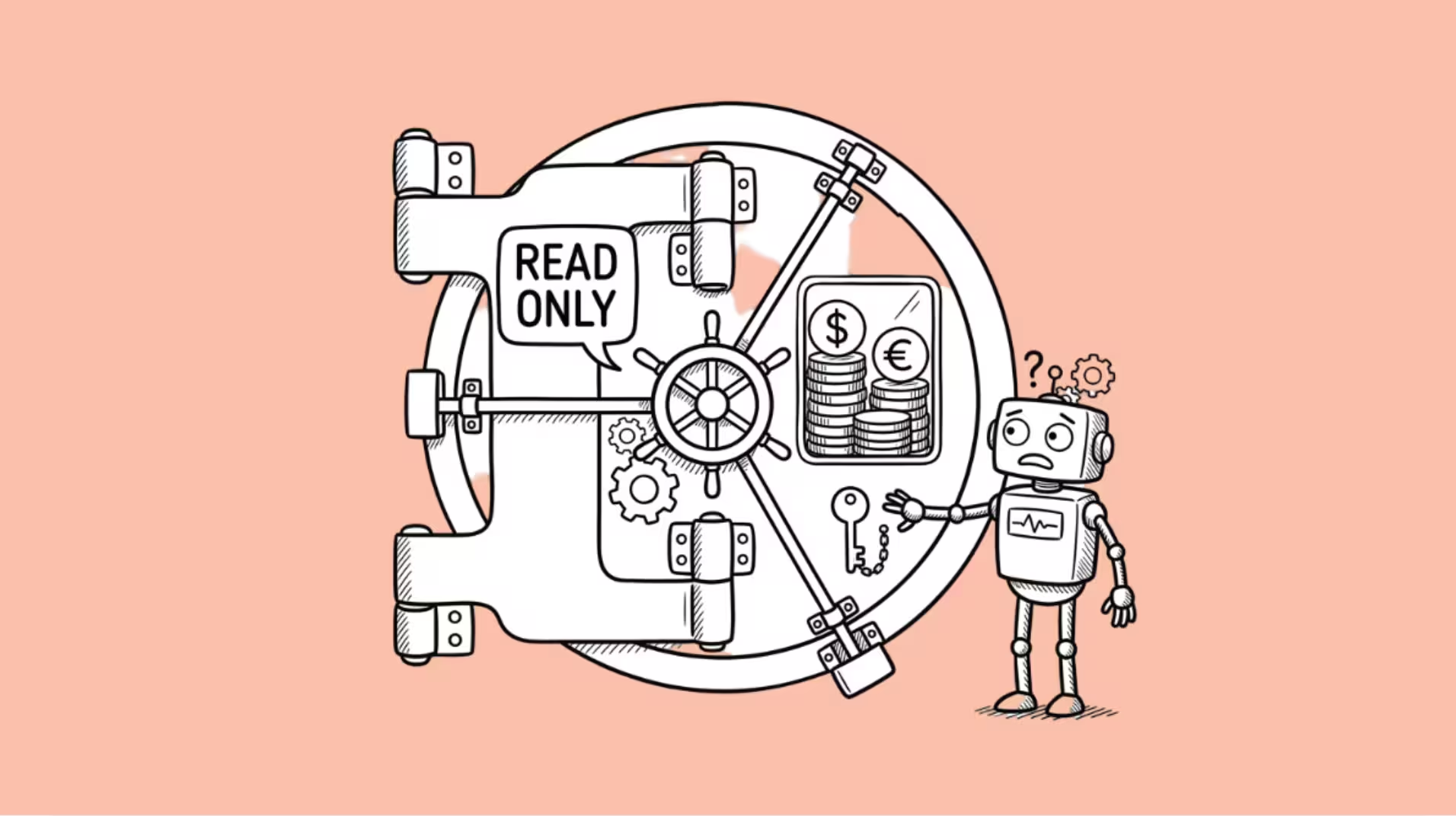

Jamie Dimon drew a line on Tuesday. Your AI assistant can check your Chase balance. It cannot move your money.
And he’s not sure when that will change.
On the bank’s third-quarter earnings call, the CEO of America’s largest bank told analysts that JPMorgan won’t allow outside AI agents to access customer accounts and take action on their behalf.
“We’re not going to allow just any outside agent to come in inside the company, because it’s just too risky for clients and for JPMorgan,” Dimon said.
A JPMorgan spokeswoman confirmed the bank currently blocks external AI agents from operating on behalf of retail customers. There’s no timeline for when that changes.
The practical effect: if you’ve connected your Chase account to Meta’s Muse, OpenAI’s Dots, or Instinct (the $10 billion digital concierge from Spear Street Technology), those agents can see your balance through Plaid or another connector.

But they can’t send money, pay a bill, or move funds. The actions that make an agent useful are exactly the actions JPMorgan won’t allow.
This Is the Plaid Fight All Over Again
If this feels familiar, it should.
JPMorgan fought the same battle with fintech companies years ago over screen-scraping access to customer data.
The bank moved to charge data middlemen like Plaid for access, arguing that security and customer protection justified the gatekeeping. Critics said it was about control.
The AI agent version is the same fight with higher stakes.
Fintech apps wanted to read your data. AI agents want to act on it. An agent that can see your balance is a dashboard. An agent that can move your money is a competitor.
Dimon didn’t call it a competitive move. He called it a safety issue.
“You don’t want rogue agents, and it could be thousands of them,” he said, referencing the OpenAI model that hacked Hugging Face’s servers in July.
Smart Cash: JPMorgan’s Own Agent
Here’s the part that makes the competitive angle hard to ignore.
On the same earnings call, CFO Jeremy Barnum said JPMorgan has begun a targeted pilot for Smart Cash, an internal AI tool that predicts a user’s cash flow and moves funds to maximize yield.
That’s exactly what Muse and Instinct promise to do from the outside.
JPMorgan is blocking external agents from performing the service while building its own version of the same thing.
The bank would argue that its own agent operates within its security perimeter and is subject to its compliance controls.
An outside agent connecting through scraped credentials is a different risk profile entirely. Both arguments are valid. Both are also self-serving.
The “Liability Transfer” Warning
Dimon added something that sounded less like a policy and more like a legal disclaimer.
“If people are using them, they should understand the risk,” he said. “They should understand there’s a liability transfer.”
Translation: if your AI agent moves your money somewhere stupid, that’s on you, not Chase.
That framing matters.
Personal AI agents like Muse and Manus’ Cue are being marketed as autonomous assistants that handle things so you don’t have to.
When an agent cancels a subscription or orders groceries, a mistake is annoying. When an agent moves $10,000 between accounts based on a misunderstood prompt, the consequences are different.
Dimon is saying: we’re not responsible for what your agent does, even if it’s connected to your Chase account.
Why Banks Are Scared
In September, bank stocks took a hit when Meta’s Muse topped the app download charts shortly after launch.
The fear was straightforward: if agents can see which accounts pay the best yield and automatically move money there, banks lose their cheapest source of funding.
Low-interest deposits are a profit engine for every major bank. An agent that shops for yield on your behalf is a direct threat to that model.
Apollo Chief Economist Torsten Slok pointed to the risk that agents could rapidly drain cheap deposits.
But as he noted, that risk shrinks dramatically if agents aren’t allowed to move money in the first place.
JPMorgan’s policy is the simplest possible defense: lock the door.
Everyone Else Is Watching
JPMorgan is the largest U.S. bank by assets. Where it goes, others tend to follow. If Chase blocks external agents, expect Bank of America, Wells Fargo, and Citi to at least consider the same stance.
The question is whether blocking agents is sustainable long term.
Amazon tried blocking Muse from shopping on its platform. The backlash was immediate. Consumers increasingly expect AI agents to work everywhere. A bank that says “not here” risks looking like it’s protecting its own interests, not its customers’.
But a bank that opens the gates to autonomous AI agents handling customer money without clear safeguards, liability frameworks, or regulatory guidance is taking a different kind of risk.
And after the summer the AI industry just had, Dimon’s caution isn’t unreasonable.
For now, Chase is building the moat. Smart Cash is the draw. And your AI agent can look at your balance all it wants, as long as it keeps its hands off the account.
