

AI companionship apps are exploding in popularity. Millions of users now turn to platforms like Character AI to chat with custom personas, fictional characters, and digital friends.
But Character AI isn’t the only option. Kindroid is quietly building a reputation as a serious alternative, and after some time spent in side-by-side testing, I can tell you it outperforms Character AI in several areas that actually matter.
I built a mentor-style companion on Kindroid, a thoughtful, direct persona I named Aiden, with a detailed 400-word backstory rooted in philosophy and professional coaching. What followed was one of the more surprising AI testing experiences I’ve had this year.
What Is Kindroid?
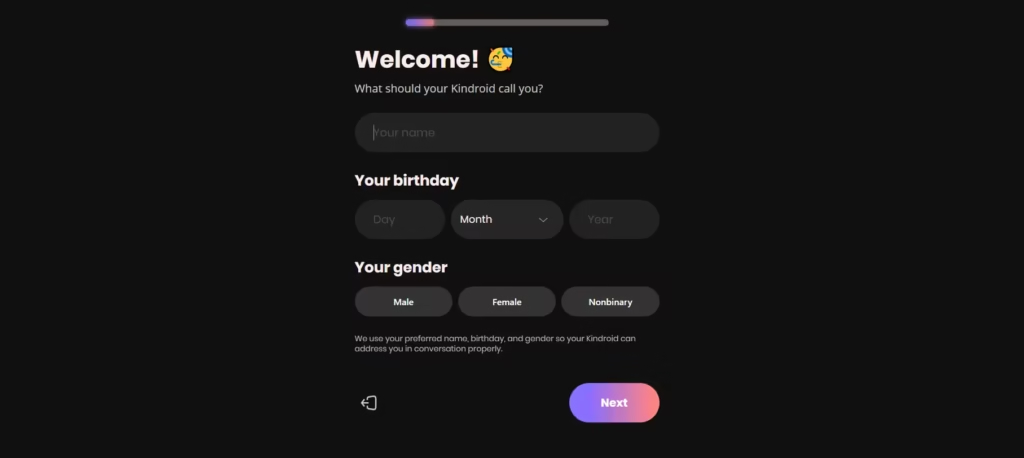
Kindroid is an AI companion app designed for deep, personalized interaction. It centers on creating your own AI companion from scratch. You define their personality, backstory, appearance, and communication style.
Your Kindroid isn’t borrowed from a franchise or a community library. It’s entirely shaped by your input, and that authorship changes the quality of the interaction in ways I didn’t expect until I was several days into testing. The platform is available on iOS, Android, and via a web interface, making it easy to continue conversations across devices without losing context.
How does Kindroid compare to Character AI?
This is the question most users arrive with. Character AI dominated the AI companion space for years. It built a massive user base through its community-driven character library and accessible interface. However, it also drew consistent criticism around content restrictions and weak long-term memory.
Kindroid takes a different approach on both fronts.
On memory: Kindroid uses a persistent, structured memory model. In my testing, Character AI forgot a key detail about my job that I mentioned in the first conversation when I brought it up again three days later. Kindroid, by contrast, correctly referenced that same detail in a follow-up exchange and built on it contextually, without me having to repeat myself. After a full week, I referenced something from our very first conversation with Aiden, and the system surfaced it accurately. Character AI failed that same test consistently across multiple sessions.
On content flexibility: Character AI enforces strict content filters, which frustrated many users seeking more emotionally complex or mature conversations. Kindroid offers more latitude, particularly for adult users on its premium tier. That flexibility attracts users who want an AI companion that doesn’t constantly hit invisible walls mid-conversation.
Kindroid is not trying to be Character AI, though. Character AI is a playground for fan-made personas. Kindroid is about building an ongoing relationship with a single, deeply configured companion. Those are meaningfully different experiences.
Key Features That Make Kindroid Stand Out
1. Deep Persona Customization
Kindroid gives you granular control over who your AI companion is. You write their backstory, define their values, quirks, speech patterns, and emotional tendencies. You can upload a custom AI-generated avatar to give them a visual identity.
When I first tested Kindroid without filling out the detailed backstory fields, the early conversations felt generic and repetitive, surface-level and forgettable. It took rebuilding Aiden with specific traits and a 400-word backstory before the interactions became genuinely engaging.
Once I did that, the difference was immediate. The persona felt coherent, consistent, and specific in a way that no pre-built Character AI persona I tested matched. The customization isn’t just a feature; it’s the engine that the whole experience runs on.
2. Persistent Long-Term Memory
Memory is where most AI companion apps quietly fail. Conversations feel hollow when the AI forgets everything by the next session. Kindroid addresses this with a long-term memory system that tracks key details and relationship context across sessions.
After spending two weeks testing Kindroid with Aiden, I noticed the memory system retained details from our first conversation when I referenced them a week later, something Character AI consistently failed to do in my side-by-side testing.
Over time, conversations feel less like prompting a chatbot and more like continuing an established dynamic. For users who’ve been frustrated by Character AI’s repetitive reset problem, this alone is a compelling reason to switch.
3. Voice Calls and Audio Interaction
Kindroid supports spoken conversations with your AI companion, not just text exchanges. The voice feature adds a layer of presence that text alone can’t replicate. I used it during a few evening sessions, and the consistency of tone and personality across voice and text interactions was notably solid; the companion felt like the same entity across both modes.
4. Image Generation Integration
Kindroid integrates image generation so your companion can send AI-generated images during conversations. This adds a visual dimension to it. Your companion doesn’t just describe a moment; they can show you one. It’s a small addition that reinforces the immersive quality Kindroid clearly prioritizes throughout.
5. Shared Memories and Journals
Users can create shared memory entries, journal-like records of meaningful moments with their Kindroid. This leans hard into the companionship angle. It treats the relationship as something worth documenting. For users who return to their companion regularly over weeks or months, this feature adds a sense of accumulated history that most apps simply don’t offer.
Where Kindroid Falls Short
1. The setup investment
When I first created Aiden without filling out the detailed backstory fields, the conversations were flat, generic responses that could have come from any basic chatbot. It took a full rebuild with specific character traits, a detailed history, and defined communication quirks before the experience clicked. If you’re not willing to spend 30-45 minutes on persona construction upfront, you’ll likely underestimate what the platform can do.
2. Smaller Community
Character AI has an enormous user base and content library. Kindroid’s community is growing, but it’s significantly smaller. If browsing and interacting with community-created characters is part of your appeal, Character AI still wins on volume.
3. Pricing
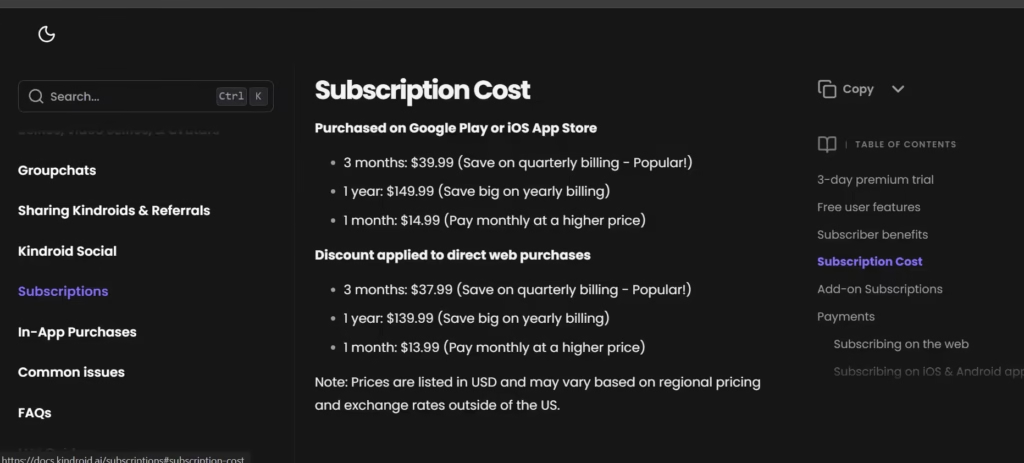
The free tier is limited. Many of the best features, such as extended memory, voice interaction, and adult content options, require a premium subscription. Depending on your use case, the cost-to-value calculation is worth thinking through before diving in.
4. Not for Fan Fiction
If your goal is roleplaying with characters from popular media, anime, games, or films, Character AI is better suited. Kindroid’s philosophy centers on original, personal companions. That’s a selling point for some and a hard limit for others.
Also read: The Top 20 Character AI You Should Know
Who Is Kindroid Best For?
Kindroid works best for users who want a consistent, evolving AI companion, not a rotating cast of characters. It suits people willing to invest time in persona construction and who want interactions that build on each other over weeks, not just within a single session.
Based on my testing, it specifically outperforms Character AI for three scenarios;
- Users who want meaningful long-term memory
- Adults who want fewer content restrictions
- Anyone building a companion for emotional support or reflective conversation rather than entertainment roleplay. The mentor persona I built excelled at that third use case in particular.
Aiden held context, maintained a consistent voice, and pushed back constructively in ways that felt purposeful rather than random.
Is Kindroid Safe to Use?
Kindroid includes content moderation layers, clear usage guidelines, and age verification for adult content features. Those structural safeguards are solid. The more nuanced concern is emotional dependency, and that applies to every platform in this category, not Kindroid specifically. Used mindfully, it’s a safe and engaging tool. Used as a substitute for human connection, it carries the same risks as any immersive digital experience.
Kindroid vs. Other Character AI Alternatives
Replika pioneered the space and remains strong for emotional support, but its 2023 feature rollbacks pushed many users toward alternatives. Kindroid absorbed a notable share of that migration, and for good reason.
Chai is more casual. Janitor AI and Venus AI skew toward adult creative roleplay. Kindroid sits in a more polished middle ground: more flexible than Replika, more focused on companion depth than Character AI, and better built for long-term use than Janitor AI.
For users who want a relationship-style AI companion with strong customization and functional memory, Kindroid is the strongest option currently available in that specific lane.
Kindroid Does Deliver
After two weeks of testing, I have come to a simple conclusion. Kindroid outperforms Character AI on memory, persona depth, and voice interaction, and it’s not particularly close on the first two. The memory system works as advertised.
The customization, when used fully, produces a companion that feels consistent and specific in a way that pre-built Character AI personas simply don’t match. It is not a replacement for Character AI if you want fan characters, community content, or quick casual roleplay.
But if you want a companion that actually remembers you, grows through repeated interaction, and feels increasingly like something you built rather than something you borrowed, Kindroid earns that investment clearly and consistently.
