


TrueFoundry and OpenRouter both solve the same problem, routing your app to the right model, but they solve it for different teams.
One bets on enterprise control. The other bets on scale and speed. We tested both to find out which one actually holds up.
What Is TrueFoundry?
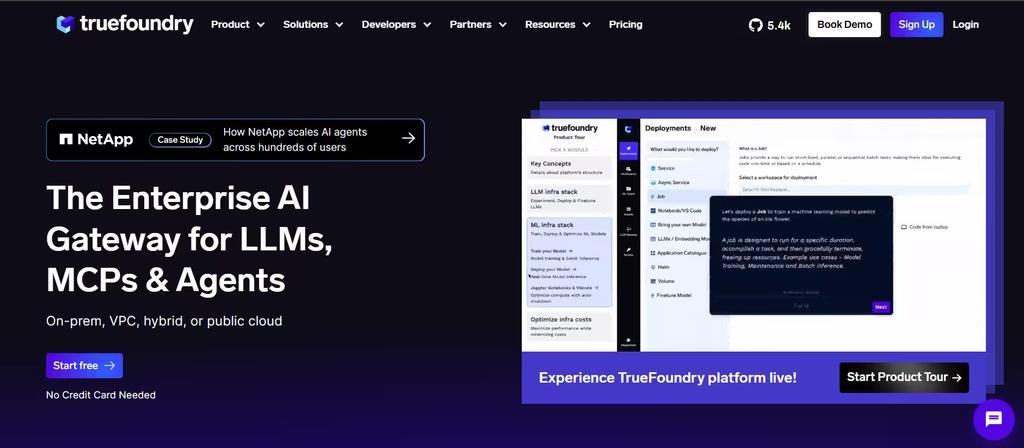
TrueFoundry started as a gateway and grew into something bigger: a full enterprise AI infrastructure platform that bundles routing, agent deployment, model hosting, and fine-tuning into one system.
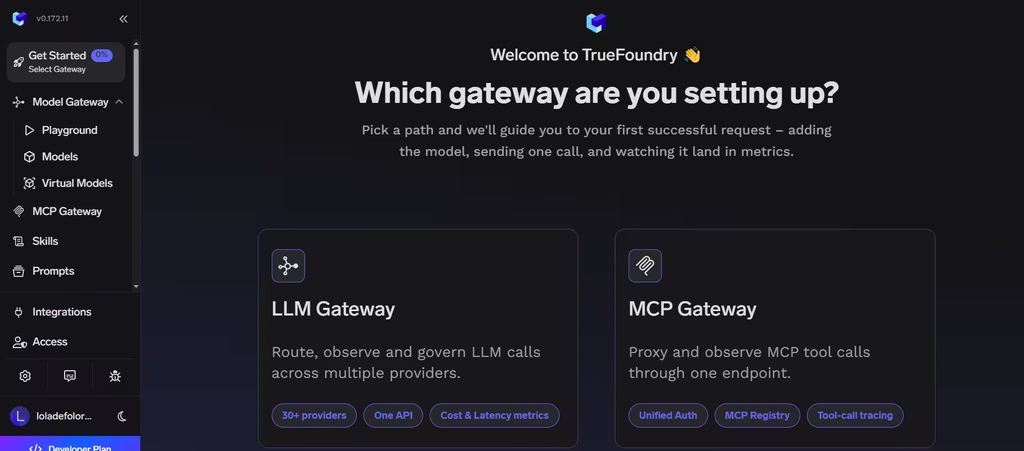
The gateway itself handles the basics well: routing, fallbacks, rate limits, cost controls, and end-to-end observability across any model. The MCP gateway goes further, becoming a dedicated layer that secures connections between agents and tools with centralized access control. Most dedicated routing tools skip this entirely.
Compliance is one of TrueFoundry’s strong suits. The platform runs on-premises or within your own VPC, and it complies fully with SOC 2, HIPAA, and ITAR standards. For banks, healthcare providers, and other regulated industries handling sensitive data, that is more important than catalog size.
The company backs this up with momentum. TrueFoundry has raised more than $21 million in funding from investors including Intel Capital, Peak XV Partners, and Eniac Ventures. It also acquired Seldon AI in mid-2026 to expand its agentic capabilities and reach more enterprise customers in finance, healthcare, and retail.
Most recently, it launched TrueForge, an open-source AI agent harness built to compete with proprietary managed-agent tools. The framework ships with over 40 built-in tools, sandboxed execution, human-in-the-loop approvals, and automatic context compaction.
Also read: Agentic AI Chat For Work: AI Chatbot For Business That Works
What Is OpenRouter?
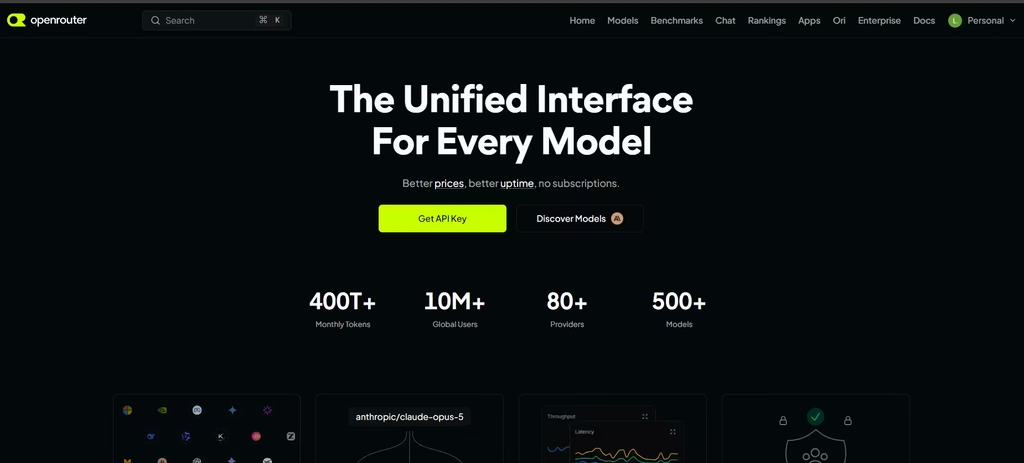
OpenRouter solves a narrower problem, and it solves it well: one API key gets you access to hundreds of models without juggling separate accounts. As of September 2026, the platform lists more than 500 active models across over 80 providers, including OpenAI, Google, Anthropic, and Meta.
There’s no subscription. Developers prepay for credits and spend them per token, and the platform charges a 5.5% fee on credit purchases. High-volume teams should weigh that against direct provider billing before committing. Teams that already hold provider API keys can skip the fee structure altogether by bringing their own keys, which removes platform fees for a generous monthly allowance before smaller charges kick in.
Investors have taken notice. OpenRouter raised $113 million in a Series B round led by CapitalG in May 2026, at a $1.3 billion valuation. Three months later, reports surfaced that payments company Stripe had agreed to acquire OpenRouter for more than $7 billion.
TrueFoundry vs OpenRouter Pricing for Workloads
Run the numbers, and the two pricing models tell different stories depending on your scale.
TrueFoundry uses tiered subscription pricing. This includes a free Developer plan covering 50,000 requests and three users, a Pro plan at $499 per month, and a Pro Plus plan at $2,999 per month. Enterprise pricing is custom.
That $499-to-$2,999 jump should be planned around, Pro Plus is the tier that unlocks stricter data controls and higher MCP tool-call ceilings, so teams with strict compliance requirements often need it well before they’ve outgrown Pro’s request volume. The upgrade gets triggered by governance needs, not just traffic.
OpenRouter charges per token, plus that 5.5% fee on credit purchases. Here’s what that looks like for a team running 1 million requests a month on a mid-tier model, say, roughly 1,000 tokens per request at a blended rate of $2 per million tokens.
That works out to about $2,000 in list-price inference, or roughly $2,110 after the platform fee. That same 1 million requests fits inside TrueFoundry’s flat $499-per-month Pro plan. The gap narrows or reverses with cheaper models or BYOK, but at this volume and price point, TrueFoundry comes out cheaper. OpenRouter’s advantage is flexibility, not necessarily lower cost at scale.
Model Access: Catalog Size vs. Self-Hosted Control
Model count isn’t close. OpenRouter’s 500-plus models from 80-plus providers mean switching models is a one-line change. Swap the model-slug parameter in your API call, and you’re done. Teams that experiment constantly or need fallback options during an outage would benefit from this.
TrueFoundry, on the other hand, connects to the major closed-source providers. But it also supports self-hosted open-source models through inference engines like vLLM, SGLang, and Triton, the only option if you’re running weights that can never leave your own infrastructure.
OpenRouter doesn’t offer self-hosting at all, since it operates purely as a cloud-based routing layer.
Deployment and Compliance
TrueFoundry deploys inside your own VPC, on-premises, or in air-gapped environments, so prompts, data, and models never leave your infrastructure. Paired with SOC 2, HIPAA, and ITAR compliance, it’s built for regulated industries and government-adjacent workloads.
OpenRouter is cloud-only. There’s no VPC or on-premises option, so teams with strict data-residency or air-gapped requirements can’t run it internally. That rules OpenRouter out for banks, hospitals, or defense contractors.
Governance and Security
TrueFoundry’s governance features starts with the basics: role-based access control and per-user rate limits. Configurable guardrails handle PII filtering and toxicity detection out of the box.
Platform teams can go further and write custom Python rules for policy enforcement, for example, a short script that scans outgoing prompts for a Social Security number pattern and blocks the call before it reaches the model. That same governance model extends through the MCP gateway, covering tool and agent access, not just LLM calls.
OpenRouter keeps things lighter. Provisioning API keys cover basic access control, letting teams issue and revoke per-developer credentials with spend limits. But SSO, SAML, and contractual SLAs sit behind the Enterprise tier. Self-serve plans skip built-in data-loss prevention and prompt-injection protection, so teams that need those controls have to build them separately or upgrade.
Which Platform Should You Choose?
For most teams building a production AI product in 2026, start with OpenRouter. The pay-as-you-go model and 500-plus model catalog let you validate product-market fit and swap models without infrastructure overhead, and our own pricing test above backs that up at typical early-stage volume.
That changes once compliance, self-hosting, or agent governance stop being nice-to-haves. Regulated industries, teams running fine-tuned or proprietary models, and organizations that need MCP-level control over what agents can touch should move to TrueFoundry directly; its flat pricing and VPC deployment options work out cheaper and safer than bolting equivalent controls onto a cloud-only router after the fact.
In short, default to OpenRouter. It’s the lower-friction, lower-cost choice for most teams shipping AI features today. However, switch to TrueFoundry the moment compliance or self-hosting becomes a contract requirement, not a someday concern; waiting until an enterprise deal forces the issue costs more than migrating early.
