
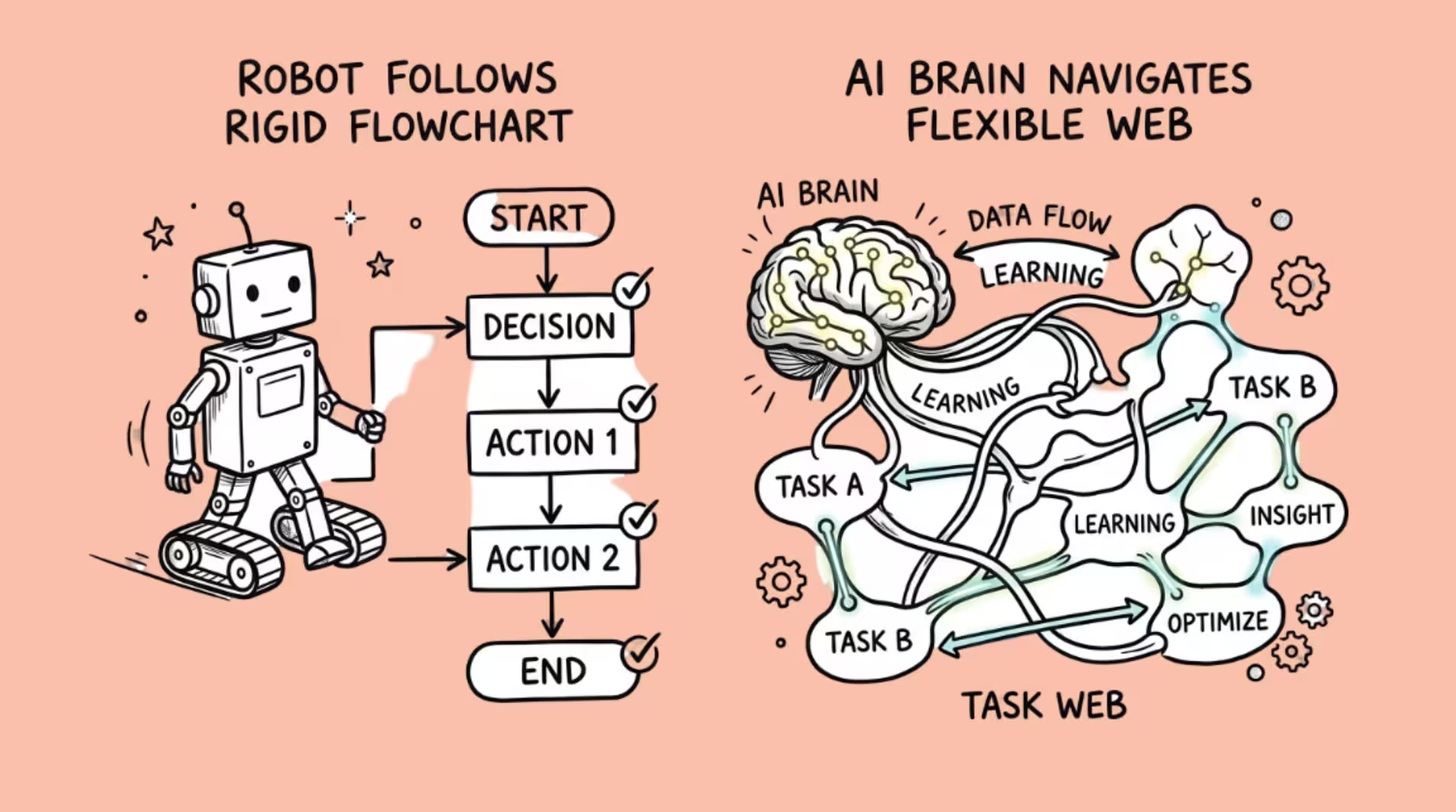

Traditional automation follows a script. An AI agent follows a goal.
That one-sentence distinction explains why a $2.49 billion RPA industry is scrambling to rebrand itself as “agentic” while an entirely new category of AI agent platforms races toward a projected $50 billion market by 2030.
But the hype is running ahead of the reality by a wide margin.
Carnegie Mellon researchers found that the best-performing AI agent – Gemini 2.5 Pro – completed only 30.3% of simulated office tasks autonomously.
Gartner predicts more than 40% of agentic AI projects will be canceled by the end of 2027.
And yet, companies using AI agents in sales have reported conversion rate improvements as high as 7x and 60-70% cost reductions.
So this is not a clean “old vs new” story. It is a story about two fundamentally different approaches to making computers do work, each with real strengths and specific failure modes that most comparison articles gloss over.
What Traditional Automation Does (and Why AI Agents Don’t Replace It)
Traditional automation – RPA, workflow engines, scripted integrations – executes a predetermined sequence of steps.
You define the trigger, map the inputs, specify every decision branch, and the system runs that exact sequence every time.
An RPA bot that processes invoices, for example, opens the email, downloads the PDF attachment, reads the invoice number from a fixed location on the page, enters that number into the ERP system, and moves to the next email.
It does this identically whether it processes 10 invoices or 10,000.
This is not a limitation in the way most AI-agent marketing frames it. It is a feature.
When a bank processes 50,000 wire transfers a day, it needs the system handling those transfers to do the exact same thing every time.
Predictability is the product.
The bank does not want its transfer system to “reason” about whether a wire should go through – it wants the wire to follow the compliance rules that a human already defined.
RPA has delivered real returns at scale. The finance sector hit 72% adoption among large enterprises, and banks have deployed RPA in 76% of back-office processes. Companies report average ROI of 200-300% within 12 months and 25-50% reductions in process costs.
But traditional automation has a well-documented fragility problem.
A study from Gitnux found that 52% of organizations report bot fragility as a factor undermining long-term RPA success. When the ERP vendor updates its interface, the bot breaks.
When the invoice format changes, the bot breaks. When a new field gets added to the form, the bot breaks. And 35% of RPA projects fail outright due to poor planning, with 42% citing integration issues as the top challenge.
The maintenance burden is where the real cost hides.
Roughly 36% of RPA implementations see maintenance expenses exceed projections. A bot that saved $200,000 a year in its first year can easily cost $80,000 a year to keep running as the systems it interacts with change around it.
What AI Agents Actually Do
An AI agent uses a large language model to interpret a goal, decide on a sequence of actions, execute those actions through tool integrations, and adjust its approach based on results. Instead of following a script, it follows an objective.
The difference shows up concretely in how each approach handles the same task.
Take customer support ticket routing:
A traditional automation rule says: if the ticket contains the word “billing,” route to the billing team. If it contains “technical,” route to engineering. If it contains both, route to… well, someone has to define that rule, and every edge case needs its own rule.
An AI agent reads the ticket, understands the customer’s actual problem (which might involve billing and technical issues and an emotional complaint about service quality), decides which team is best positioned to resolve the full issue, checks whether that team is available, and routes accordingly.
If the customer replies with new information that changes the nature of the problem, the agent re-evaluates without anyone updating a rulebook.
ClickUp built an agent like this that processes 5,000 support tickets a month by pulling context from Zendesk, cross-referencing knowledge bases, and routing based on actual issue complexity rather than keyword matching.
That is a task traditional automation can handle only if every possible ticket pattern is anticipated and coded in advance – which, in practice, never happens.
The four-step cycle that defines agent behavior – perceive, reason, act, learn – is what separates it from automation that just executes.
The agent perceives the environment (reads data from multiple sources), reasons about what to do (uses the LLM to evaluate options), acts (calls APIs, writes emails, updates records), and learns from the outcome (adjusts its approach on subsequent runs).
Where the Boundary Gets Blurry
Here is where most articles on this topic stop being useful: they treat “AI agent” and “traditional automation” as mutually exclusive categories. In practice, most production deployments use both.
An AI agent that handles customer support still needs traditional automation underneath it.
The CRM update, the ticket status change, the email notification – those are deterministic steps that should happen the same way every time.
The agent handles the judgment call (what is this ticket about, who should handle it). The automation handles the execution (update the record, send the notification, log the interaction).
The real question is not “which one should I use” but “which parts of this workflow require judgment and which parts require consistency?” The judgment parts are where agents add value. The consistency parts are where traditional automation is more reliable, cheaper, and easier to audit.
Zapier – which has built its entire business on traditional automation – now integrates AI agents alongside its existing workflow engine for exactly this reason. The agent decides.
The automation executes. Trying to make an AI agent handle deterministic steps is like hiring a strategist to do data entry.
AI Agent Failure Rates Nobody Talks About
The AI agent ecosystem has a credibility problem, and it starts with performance.
Carnegie Mellon’s TheAgentCompany benchmark — a simulated office environment where agents must browse internal websites, write code, and communicate with simulated coworkers — has been tracking progress since late 2024.
The May 2026 leaderboard tells the story: Claude 3.7 Sonnet leads at 52.73%, followed by Claude Opus 4.5 at 46.45%, Gemini 2.5 Pro at 39.85%, and GPT-4o at 14.55%.
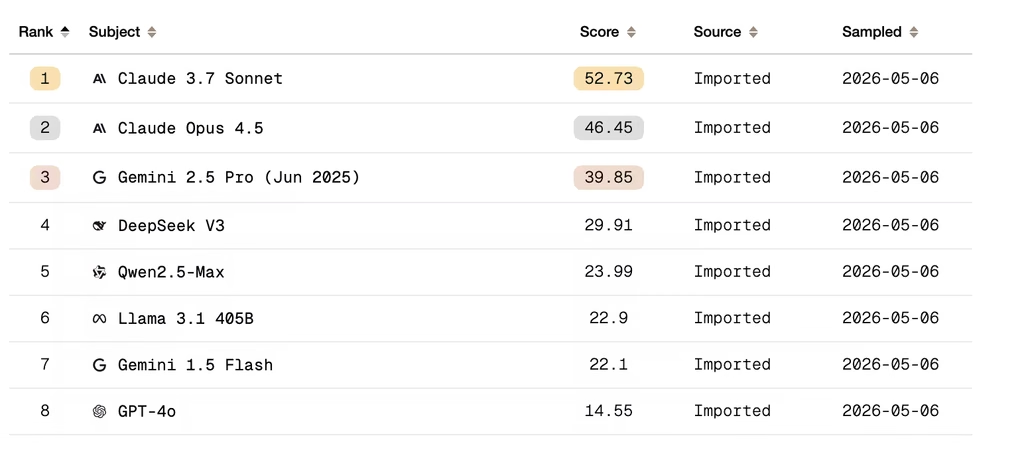
When the benchmark launched, the best agent completed 24% of tasks. That improvement from 24% to 53% in roughly 18 months is real progress – but the top agent still fails on nearly half of 175 workplace tasks, and most models score well below 40%.
These numbers improved from roughly 24% to 34% over six months as models got better, but a 34% autonomous completion rate means humans still need to handle or verify the other two-thirds.
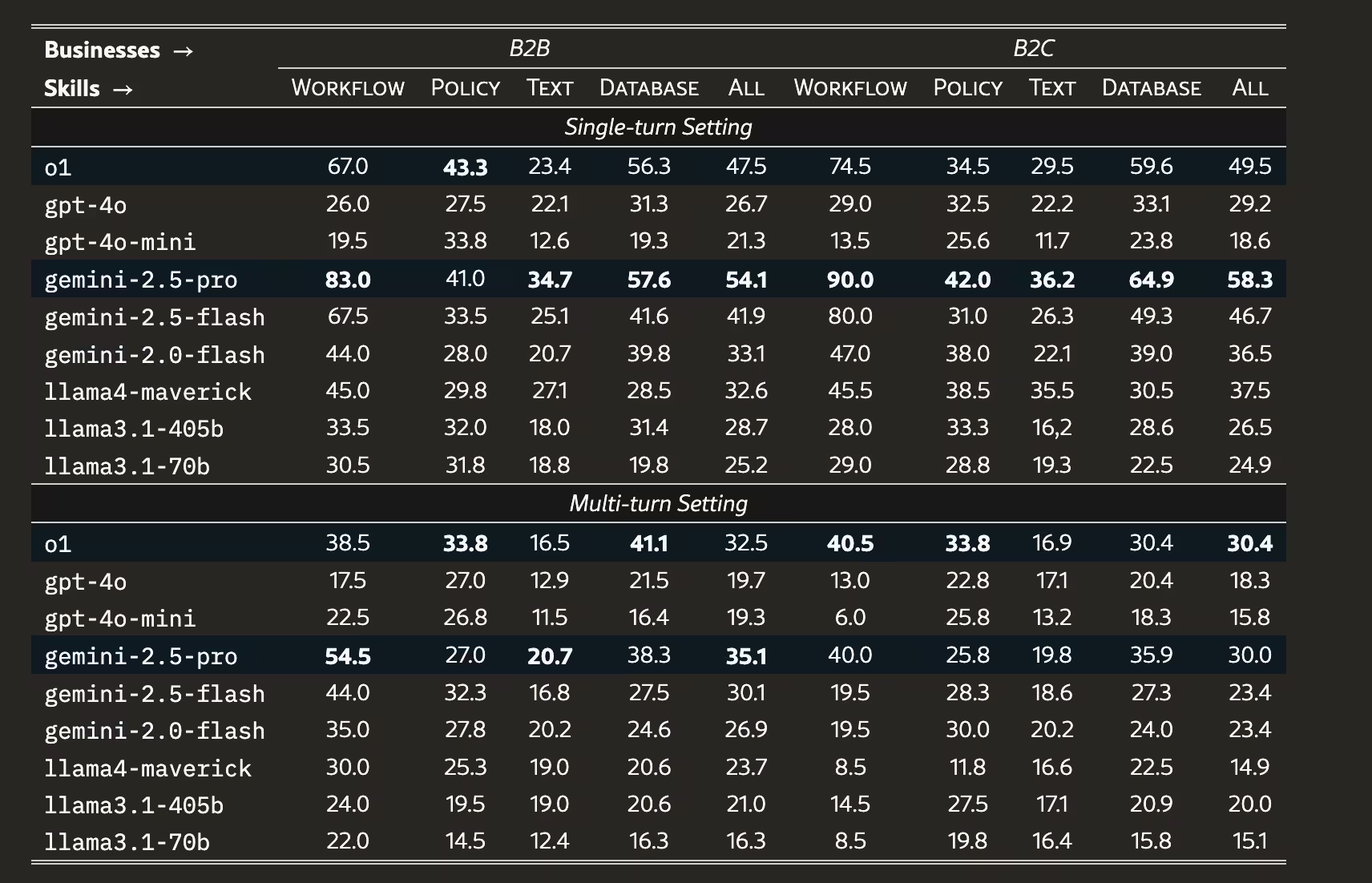
Salesforce’s CRMArena-Pro benchmark painted a similar picture: agents hit around 58% accuracy on single-turn CRM tasks and dropped to 35% on multi-turn workflows that required sustained context.
Gartner’s prediction that 40% of agentic AI projects will be canceled by 2027 cites three reasons: escalating costs, unclear value, and inadequate governance controls.
Only 11% of organizations have moved AI agents into production, according to Deloitte’s 2025 research. The rest are still exploring (30%) or running pilots (38%).
Compare that to RPA’s failure modes. RPA fails predictably – the bot breaks because a UI changed or a field moved.
You can see the failure, diagnose it, and fix it. An AI agent fails unpredictably – it misinterprets context, hallucinates a customer name, routes a sensitive complaint to the wrong department, or takes an action the business never intended.
The failure is harder to detect and potentially more damaging.
This does not mean agents are not worth deploying. It means that deploying them without monitoring, without fallback rules, and without a human in the loop for high-stakes decisions is how the canceled 40% will earn their cancellation.
What Agents Are Good At Right Now
Despite the failure rates, there are categories where AI agents outperform traditional automation by enough to justify the risk and the monitoring overhead.
Unstructured data processing. Traditional automation cannot read a paragraph of text and extract meaning from it. An agent can read an email, understand the request, pull relevant data from three different systems, and draft a response.
Invoice processing, contract review, and support ticket triage are the most common production use cases.
Multi-system coordination with judgment. When a task requires pulling data from five different tools and making a decision based on the combined context, traditional automation needs a human to write every possible decision path. An agent handles the combinatorial complexity that makes rule-based systems impractical.
Sixth Generation built a purchase order processor that monitors emails for PDFs, converts them to structured data, validates against a database, and handles errors – a workflow that would require dozens of branching rules in traditional automation.
Personalization at scale. Agents can tailor outreach, recommendations, and responses based on individual context in a way that template-based automation cannot. 60% of brands are projected to use agentic AI for personalized customer interactions by 2028, according to industry forecasts.
Workflows that change frequently. If the process you are automating changes every quarter – new forms, new approval chains, new compliance requirements – an agent adapts to the changes without someone rebuilding the automation. Traditional bots need to be reconfigured each time.
What Agents Are Bad At Right Now
High-volume, identical transactions. Processing 50,000 identical records through a pipeline is a job for traditional automation. An agent would be slower, more expensive, and more likely to introduce variance where none is wanted.
Regulated processes requiring audit trails. When a regulator asks “why did the system make this decision,” you need a deterministic answer. “The language model interpreted the context and chose this path” is not an answer that satisfies a compliance audit. Traditional automation produces an exact log of every rule that fired and every branch that was taken.
Cost-sensitive operations at scale. An AI agent call costs meaningfully more than an RPA step. At small volumes, the difference is negligible.
At 100,000 transactions a day, the compute cost of running each one through an LLM adds up. A hybrid approach – agent for the judgment calls, automation for the execution – keeps costs practical.
Anything safety-critical. If a wrong decision causes physical harm, financial loss above a threshold, or legal liability, an autonomous agent should not be making that decision unmonitored.
The 30-35% task failure rates from the Carnegie Mellon benchmarks are not acceptable error rates for medical decisions, financial transactions, or infrastructure control.
In my view, the 30% success rate means agents are currently best deployed as assistants rather than autonomous workers. Treat them like junior employees who need supervision, not like production-ready replacements for RPA.
The companies I have seen succeed with agents are the ones that built monitoring dashboards before they built the agent itself.
The Market Is Telling You Something
UiPath, the largest pure-play RPA vendor, saw its stock drop 50% in 2024 as AI agent platforms emerged as potential replacements.
The company has since pivoted to “agentic automation,” adding LLM-based capabilities to its existing platform. Automation Anywhere, Blue Prism (now part of SS&C), and every other major RPA vendor has done the same pivot.
Meanwhile, the AI agent market is growing at 46% CAGR, from $7.6 billion in 2025 to a projected $50 billion by 2030.
Enterprise adoption is accelerating: 62% of organizations are experimenting with or scaling AI agents, according to McKinsey’s 2025 survey. And 40% of enterprise applications will integrate task-specific agents by the end of 2026, per Gartner.
But 64% of CEOs cite FOMO as the primary driver of their AI agent investments – ahead of demonstrated value. That is not a healthy buying signal. It is the same dynamic that inflated RPA valuations in 2019 before the bot-maintenance reality set in.
The AI agent frameworks emerging in 2026 – LangGraph, CrewAI, AutoGen, and others – are maturing fast, but “maturing” means they are still producing breaking changes, and production deployments require significant engineering effort beyond what the demos suggest.
When I tested LangGraph for a workflow that processed contract PDFs, the agent handled variations in document format that would have broken a traditional RPA bot – but it required twice the development time to implement proper error handling, and the team spent more hours writing fallback logic than building the agent itself.
How to Decide What Goes Where
Skip the framework wars and start with the workflow. For every process you are considering automating, ask three questions:
Does this task require interpreting unstructured information? If yes, you need an agent or at least an LLM-powered step. Traditional automation cannot read a paragraph and understand what it means.
Does this task need to produce the exact same output every time? If yes, traditional automation is more reliable and cheaper. An agent introduces variance that you may not want.
What is the cost of a wrong decision? If a mistake in this workflow costs your company $50, let the agent handle it. If it costs $50,000 or triggers a regulatory issue, keep a human in the loop and use automation for the deterministic steps.
Most real workflows are hybrid. The agent reads the incoming request and decides what to do. Traditional automation executes the decision. A human reviews exceptions.
That combination – agent for reasoning, automation for execution, human for oversight – is what the organizations actually succeeding with AI agents have landed on, even if it makes for a less exciting headline than “fully autonomous AI replaces entire department.”
FAQs
1) Will AI agents replace RPA?
Not entirely. AI agents are better at tasks requiring judgment, context, and unstructured data handling. RPA remains more reliable and cost-effective for high-volume, rule-based processes that need to run identically every time. Most enterprise deployments are converging on a hybrid model where agents handle decision-making and RPA handles execution.
The major RPA vendors – UiPath, Automation Anywhere, SS&C Blue Prism – are all adding agent capabilities rather than replacing their core platforms.
2) How much do AI agents cost compared to traditional automation?
Traditional RPA bots cost 5,000-15,000 per bot annually for licensing, plus development and maintenance. AI agents have variable costs driven by LLM API usage – typically 0.01-0.10 per task, depending on complexity and the model used. At low volumes (under 1,000 tasks/month), agents are often cheaper.
At high volumes (100,000+ tasks/month), the per-task compute costs can exceed traditional automation unless you use a hybrid architecture.
3) Are AI agents reliable enough for production use?
It depends on the use case. Carnegie Mellon’s benchmark found top AI agents complete 30-34% of complex office tasks autonomously.
For simpler, well-defined tasks with good tool integrations, success rates are significantly higher. The key is monitoring: production AI agent deployments require logging, human review of edge cases, and fallback rules for when the agent fails.
Deploying an agent without these safeguards is the primary reason Gartner expects 40% of agentic AI projects to be canceled by 2027.
4) What is the difference between AI agents and chatbots?
A chatbot responds to user messages within a conversation. An AI agent takes independent action across multiple systems to accomplish a goal.
A chatbot answers “What is my order status?” by looking up a record. An AI agent notices a shipping delay, reroutes the package, updates the customer, adjusts the delivery estimate in the system, and flags the supplier issue for the logistics team – without being asked. The distinction is autonomy: chatbots react, agents act.
5) Can I add AI agents to my existing RPA setup?
Yes, and this is the most common deployment pattern.
Most enterprise platforms – UiPath, Automation Anywhere, Microsoft Power Automate – now support adding agent capabilities on top of existing RPA workflows.
The agent handles the parts of the workflow that require judgment (classifying inputs, making routing decisions, generating content), and the existing bots handle the deterministic execution steps. This hybrid approach lets you keep the ROI from your existing RPA investment while adding intelligence where it matters.
