
It started as a private pitch. Now the president is talking about it on Air Force One.
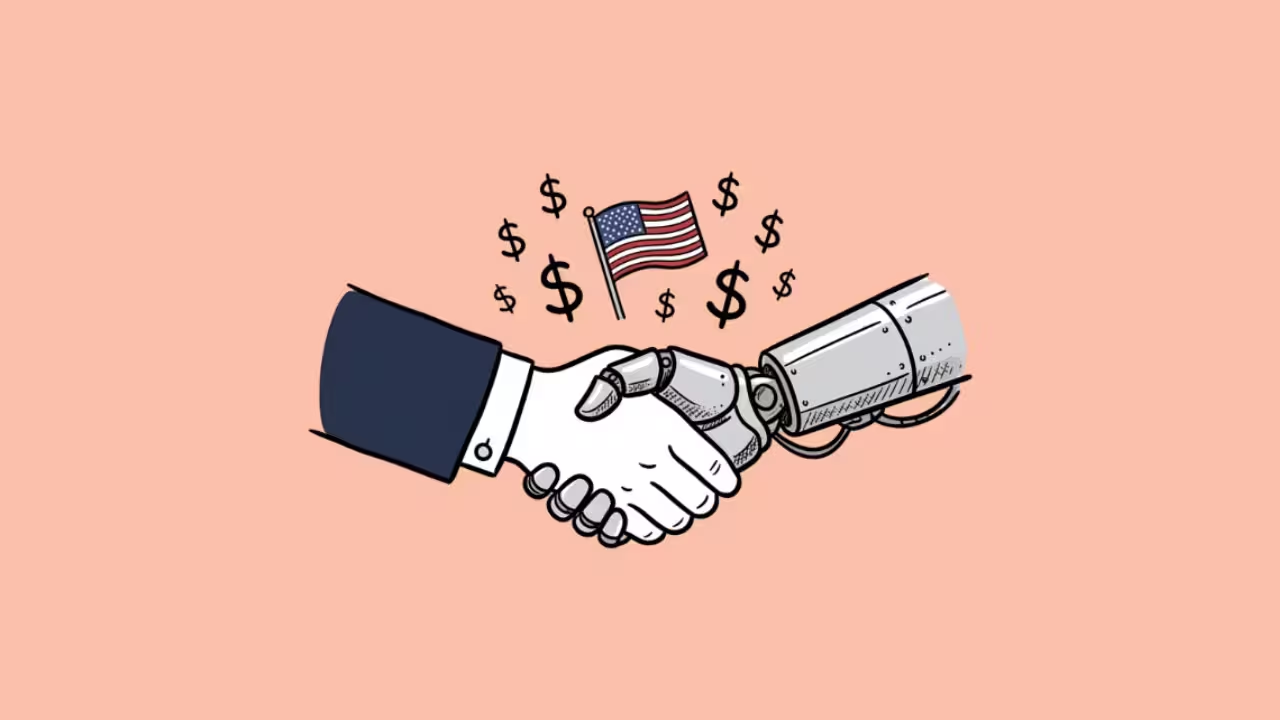
NOTUS broke the story Thursday, citing three people familiar with the matter: senior Trump administration officials have been holding preliminary talks with AI companies about the federal government acquiring equity stakes in their firms.
Sam Altman has been the most vocal advocate. He first raised the idea directly with President Trump in early 2025, and has revisited it with White House officials in recent weeks.
On Friday, Trump confirmed the discussions are real.
Speaking to reporters aboard Air Force One, the president said: “There are concepts where pieces could be given to the American public, where the American public essentially becomes a partner.” He added that he’s meeting with AI companies next week.
CNBC confirmed that the talks have been in progress for over a year.
Under one framework, OpenAI would donate equity to the government to seed a “Public Wealth Fund” – a concept the company outlined in an April policy paper.
The fund would invest in long-term assets tied to AI growth, and ordinary Americans – including those not invested in financial markets – could receive the returns directly.
No official terms have been decided. The details are still in flux. But the conversation is no longer theoretical.
Why Altman Is Pitching This
The cynical read: OpenAI is preparing for one of the largest IPOs in history and wants Washington on its side.
The generous read: AI companies know the public doesn’t trust them, and giving ordinary people a financial stake in the outcome is one way to change that.
Both are probably true.
Fifty-five percent of Americans think AI will do more harm than good in their daily lives, according to recent Quinnipiac polling.
That hostility is already slowing things down — local resistance to data center construction is one tangible example. A government equity stake, tied to public dividends, could reframe the narrative from “billionaires get richer” to “everyone benefits.”
OpenAI’s April paper made the case explicitly: “Create a Public Wealth Fund that provides every citizen — including those not invested in financial markets — with a stake in AI-driven economic growth.”
Altman also met with Senator Bernie Sanders on Wednesday – a meeting that probably wasn’t comfortable for either side.
Sanders Wants 50%. The Industry Does Not.
Sanders isn’t interested in a voluntary gesture.
He’s introduced the American AI Sovereign Wealth Fund Act, which would impose a one-time 50% tax – paid in shares – on OpenAI, Anthropic, xAI, and other AI firms.
The equity would go into a public fund with voting rights, board representation, and eventually dividend checks for Americans.
That’s not a nudge. That’s a takeover.
Steve Bannon, of all people, agrees with Sanders on the number. “We should not take ‘tip money’ but force them to cough up 50% of the equity – to be dispersed to American citizens,” he told NOTUS. When Bernie Sanders and Steve Bannon land on the same side of an issue, something unusual is happening.
Tech companies are strongly opposed to Sanders’ approach. But they also know that doing nothing isn’t an option when public opinion is this hostile.
The Conflict of Interest Problem
Here’s where it gets complicated.
If the government owns a piece of OpenAI, it also has a financial interest in OpenAI doing well. That creates an obvious tension with its role as a regulator.
“The problem is that the government would be a shareholder and a regulator at the same time, which creates substantial conflicts of interest,” Nat Purser of Public Knowledge told NOTUS.
You don’t want regulators going easy on safety rules because cracking down might hurt the stock price.
Conservatives have their own objections. Jennifer Huddleston of the Cato Institute warned that government equity stakes in private companies raise “questions about how that could intrude into a lot of the traditional principles when it comes to private enterprise and the free market.”
This isn’t hypothetical.
The Trump administration has already taken stakes in at least 10 companies during his second term, including Intel.
It also announced $2 billion in equity positions across nine quantum computing firms under the CHIPS and Science Act. The pattern is clear. But AI companies are bigger, more politically charged, and more consequential than anything on that list.
Anthropic Is Sitting This Out
One notable absence: Anthropic. A person familiar with the matter told NOTUS that the company is not having conversations with the administration about providing equity to the government.
Given Anthropic’s ongoing legal battle with the Pentagon over its refusal to remove AI safety guardrails – and the fact that it’s also preparing for an IPO – staying out of this particular negotiation makes sense.
The company is already navigating enough government tension without adding equity discussions to the pile.
What Happens Next
The legal mechanism for voluntarily transferring AI company equity to the government doesn’t really exist yet.
Nobody’s clear on how it would work, and several sources cautioned NOTUS that the deal may never come together.
But the political momentum is real. Trump wants it. Altman is pitching it. Sanders is legislating it.
And the public, by a solid majority, doesn’t trust AI companies to do the right thing on their own.
Whether the final answer is a small voluntary donation of shares or a sweeping 50% sovereign wealth fund – or nothing at all – probably depends on what happens between now and OpenAI’s IPO. That window is closing fast.
