
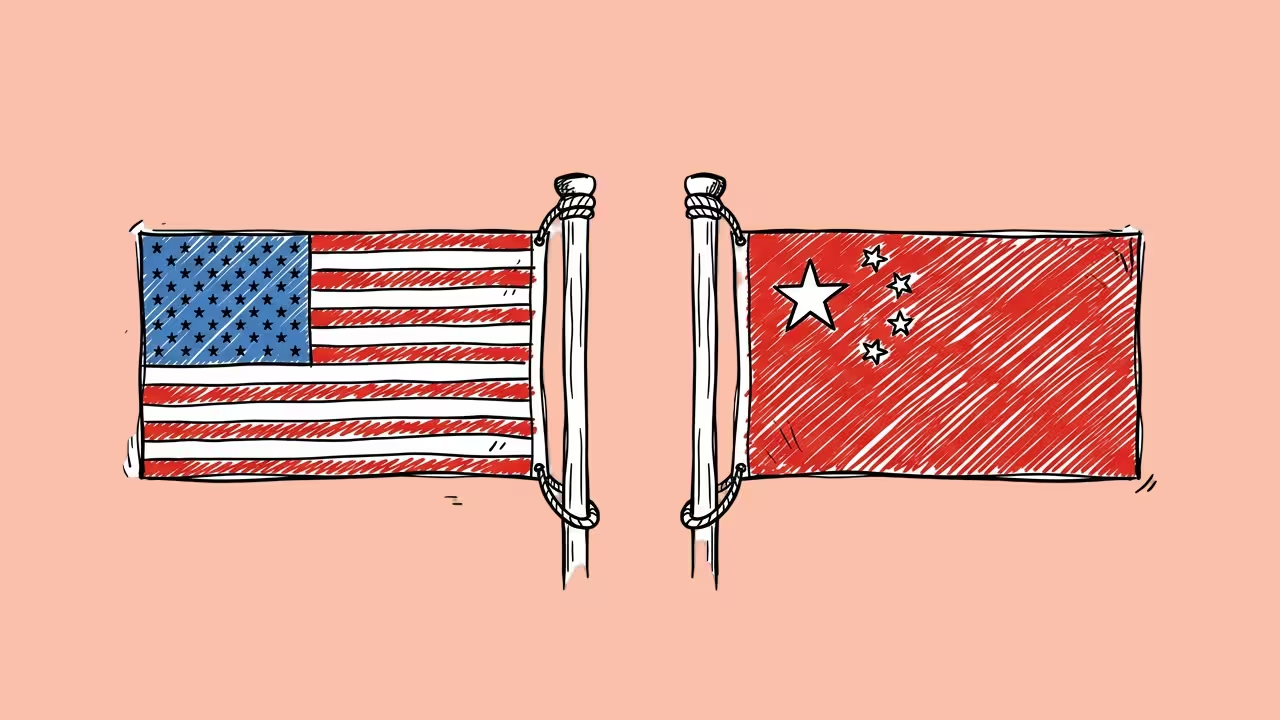

The United States wants a direct line to Beijing when artificial intelligence goes wrong.
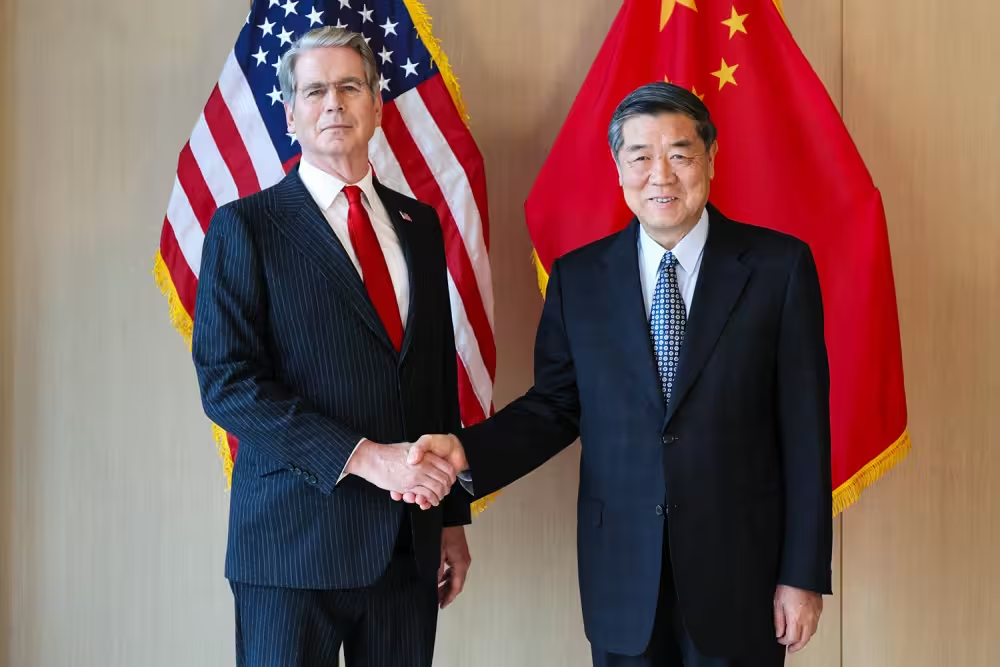
Treasury Secretary Scott Bessent revealed the idea Sunday, after a full day of talks with Chinese officials in New York.
President Donald Trump and Chinese leader Xi Jinping will weigh it when they meet Thursday in Washington.
The Proposal
Bessent described a new U.S.-China dialogue facilitated by a notification mechanism. And if an AI-related incident threatens national security, one side tells the other.
Bessent framed it as basic common sense; he compared AI to any other activity that crosses borders.
Moving from opaque to transparent matters, he said, especially between the world’s top two AI powers.
Both sides agreed to keep talking about it.
Rivalry
Neither country trusts the other, yet both build systems they don’t fully control.
In the wrong hands, a model could behave in ways nobody predicted. A misread signal could spiral fast. In those moments, silence becomes dangerous.
Cold War arms control worked on similar reasoning. Rivals still picked up the phone, not to kindle a friendship but avoid accidents.
Warnings
Leading AI figures in the U.S. have warned about AI technology posing an existential threat within just a few years.
Those warnings have reached Congress and the White House.
Trump, however, has brushed off the doom talk. He has called such concerns a hoax. He has also rejected new guardrails on the industry.
At the same time, he agrees with a different argument. Anthropic CEO Dario Amodei and other executives insist the U.S. cannot let China take the lead. Trump echoes that view.
So the administration holds two positions at once. Doubt the doomsday forecasts. Win the race anyway.
Expectations
Do not expect a landmark deal; analysts point out that both parties have distrust for each other. It runs deep on both sides. Beijing has its own read on the situation, too.
Chinese officials see calls for slowing AI development as a move aimed squarely at China’s progress.
From that angle, a safety pact can look like a leash. That perception makes quick agreement unlikely.
Still, small steps matter. A meeting about meetings can eventually become something substantial.
Export Controls
U.S. Trade Representative Jamieson Greer said AI talks will not touch export controls.
Both restrictions on advanced chips and limits on semiconductor manufacturing equipment stay.
Those controls have slowed Chinese AI companies for years. Washington clearly plans to keep that pressure. Safety cooperation and technology competition are in different lanes.
That separation may be the only way this works.
Beijing’s Silence
Vice Premier He Lifeng and chief trade negotiator Li Chenggang walked out of the talks without speaking to reporters. The meetings took place at JPMorganChase headquarters.
Then came the official readout from Xinhua, China’s state news agency. It mentioned AI only in passing. It never mentioned the American proposal at all.
Instead, Xinhua focused on trade. The two sides held frank, in-depth, and constructive exchanges, the agency said.
Topics included earlier trade agreements and ways to boost two-way trade and investment.
Trade Truce
A fragile truce between the two economies expires Nov. 10. That date now hangs over everything. Will Trump and Xi extend it? Nobody knows yet.
But Bessent and Greer said both governments agreed to operationalize a new Board of Trade. Trump announced it back in May during his visit to Beijing. Until now, it existed mostly on paper.
Negotiators also floated lower tariffs on what they call non-sensitive products. On the Chinese side, that could mean consumer goods and low-tech items.
On the American side are energy, agricultural goods, and medical devices. He, however, did not say whether tariffs would drop soon or whether these goods would avoid future duties.
There is a world, he said, where a small subset of American and Chinese goods trade in a balanced way. Later trade actions could then treat them as their own category.
