

In February 2026, Nebraska attorney Greg Lake stood before the state Supreme Court to argue a divorce appeal. The justices stopped him 37 seconds in. Of the 63 citations in his brief, 57 turned out to be defective. Twenty were outright hallucinations. Three cited cases that didn’t exist in any jurisdiction. Lake was suspended indefinitely, the first such suspension tied directly to AI hallucination in U.S. history.
This is what hallucination looks like in 2026. It isn’t obviously broken text anymore. It’s confident, well-formatted, and wrong. This article details the current data on AI hallucinations, real-world consequences, and how to catch these errors before they cause damage.
What Counts as an AI Hallucination
A hallucination happens when an AI system states something false with full confidence. It might invent a statistic,t cite a study that doesn’t exist, or misquote a real source entirely. Researchers now split hallucinations into distinct types.
Faithfulness hallucination happens during summarisation. The model adds facts that weren’t in the source document. Factual hallucination happens during open-ended questions; the model states something untrue about the world. Citation hallucination happens during research tasks. The model invents a source, a DOI, or an author name that sounds real but isn’t.
OpenAI researchers have an explanation for this. Standard training rewards guessing over honesty. It’s very similar to a multiple-choice test. A blank answer guarantees zero points, but a guess might get lucky. Therefore, models learn to guess.
Smarter Models, New Failure Modes
Reasoning models, the “thinking” systems built for deeper analysis, often hallucinate more on open-domain questions than older, simpler models.
OpenAI’s o3 model hallucinated 33% of the time on the PersonQA benchmark. That’s double the rate of its predecessor, o1. Industry researchers call this the “reasoning tax.” Independent benchmarks confirm that thinking models tend to hallucinate on facts more often than others.
Hallucination Rates
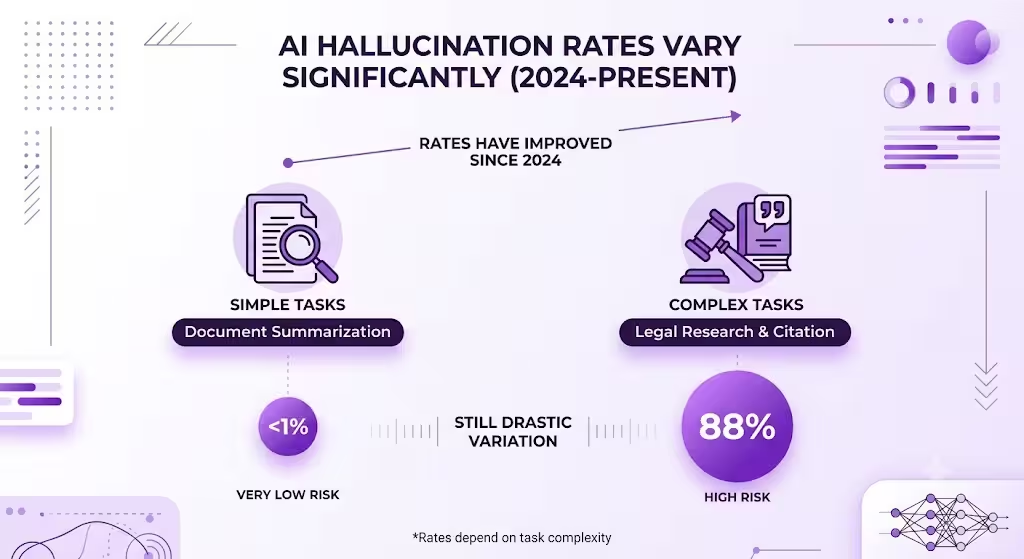
Numbers vary wildly by task type. A 2026 study spanning five frontier models and 5,000 prompts found hallucination rates between 3.1% and 19.1%, depending on model and task. That’s an improvement from 2024, when baseline rates ran from 15% to 45%. Still, there is a gap between the best and worst performers.
Task type is the main determinant of performance. On document summarisation, top models like Gemini-2.0-Flash score below 1% error. But push into open-ended factual questions, and rates climb sharply.
Legal research shows the starkest contrast. Models answering legal queries hallucinate between 17% and 88% of the time, depending on the model and question type. Even purpose-built legal AI tools have exceeded 34% error rates.
Citation accuracy isn’t very strong either. Even with extended thinking turned on, average hallucination on citation tasks sits around 12.4%. Fabricated citations look real, and invented DOIs follow proper formatting.
The same goes for made-up author names and journals that mimic real naming conventions. This can make errors harder to spot. Detection requires checking the actual source database and fact-checking everything an AI model spits out.
Real-World Consequences
After the Nebraska case, U.S. courts issued more than $145,000 in AI hallucination sanctions in the first quarter of 2026 alone. Canadian courts reported at least 167 filings containing hallucinated citations across 51 courts and tribunals by mid-June. An Australian court penalised a lawyer for using fake AI-generated documents with fake legal citations.

Healthcare risk: ECRI’s 2026 health technology hazards report ranked AI chatbot misuse as the single greatest hazard of the year. General-purpose chatbots aren’t regulated as medical devices, yet more than 40 million people consult them daily for health information.
Detection is also difficult. A benchmark built from 10,000 medical question-answer pairs found that even top models caught only a fraction of subtle false statements, with the best model reaching just 0.625 on a standard accuracy measure.
Financial cost: Global financial losses tied to AI hallucinations reached $67.4 billion in 2024, and the trend hasn’t reversed. Sometimes the errors have intent and are linked to fraud. That’s what insurance companies in the U.K. had to battle with.
These examples underline that confident, well-formatted output slips past human review most of the time. That’s the core danger in 2026.
What Reduces Hallucination (Ranked by ROI)
1. Enable web search: This delivers the biggest single reduction, 73% to 86% fewer errors across tested models. In my view, this is the single most cost-effective intervention for teams not yet using enterprise RAG systems, as it only requires reconfiguration, not a rebuild. Small teams and solo users should start here.
2. Implement RAG for domain-specific work: Retrieval-augmented generation cuts hallucination rates by up to 71% when properly implemented. This takes more engineering effort than flipping on a web search. Therefore, it makes the most sense for mid-size teams running repeated queries against a known document set, legal research, internal knowledge bases, or customer support.
3. Build a verification layer: Switching from a 4% model to a 2% model sounds significant. But it barely touches deeper issues like messy retrieval pipelines or stale source data. Larger organisations, especially in regulated industries, get more value from traceability, the ability to show what source shaped an answer, than from chasing marginal model improvements.
This is the most reasonable option starting this year. This is because the EU AI Act’s transparency rules take effect in August 2, 2026, with penalties for high-risk violations.
How to Spot Hallucinations
- Verify every citation (DOIs and author names) against real databases like Crossref or Semantic Scholar.
- Treat suspiciously exact numbers with caution. That’s because citation-accuracy research shows models fill uncertain slots with plausible-looking specifics, well-formed DOIs, and believable author names, rather than admitting they don’t know.
- Cross-check high-stakes domains always. Legal, medical, and financial outputs need human verification, no exceptions.
- Enable grounding tools like web search and RAG when available.
AI Hallucinations in 2026
AI hallucination didn’t vanish as models improved; it relocated instead. Simple, well-defined tasks now have very low error rates. But complex reasoning, legal research, and citation-heavy work still bear some risk, sometimes higher than before. The key is, don’t judge reliability by how confident an answer sounds. Judge it by whether you can trace it back to a real source.
