
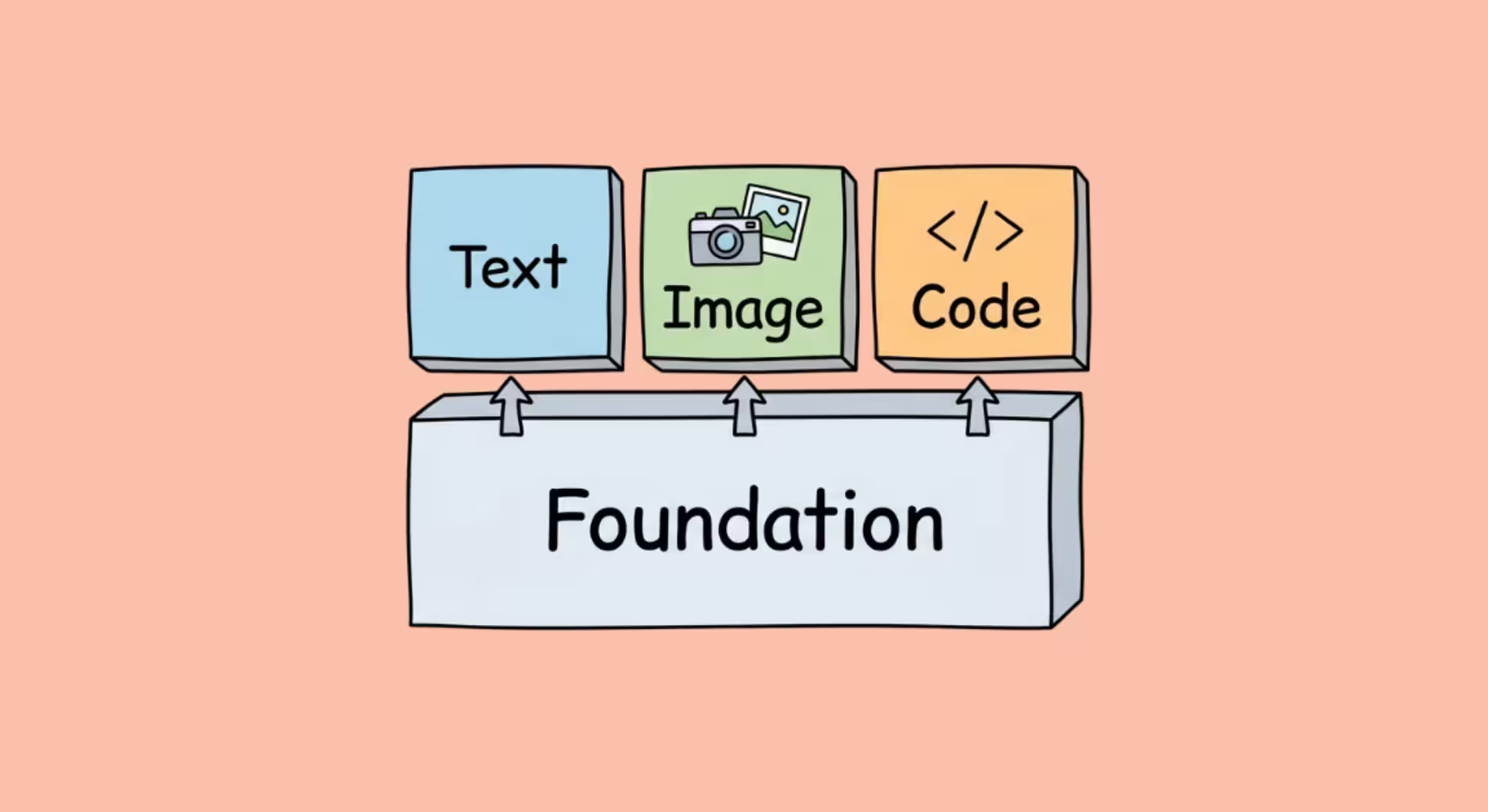

Foundation models are the reason AI went from a research curiosity to a technology that 400 million people use weekly.
Every time you talk to ChatGPT, generate an image with Midjourney, or get a code suggestion from Copilot, a foundation model is doing the work underneath.
But the term gets confused with “large language model” and “generative AI” constantly, even by people building with these tools.
The three terms describe different things at different levels of the stack, and mixing them up leads to bad architecture decisions, wasted budgets, and conversations where business teams and engineers talk past each other.
This article explains what a foundation model actually is, how the technology works at each stage (pretraining, fine-tuning, alignment), where it sits relative to LLMs and generative AI, and which specific models power the products you already use.
What Is a Foundation Model?
A foundation model is a large AI model trained on massive, broad datasets using self-supervised learning so it can be adapted to a wide range of tasks without being rebuilt from scratch.
It is called a “foundation” because it serves as the base layer that other applications, products, and specialized models are built on top of. GPT-5, Claude, Gemini, Llama, and Stable Diffusion are all foundation models.
The term was coined by Stanford’s Center for Research on Foundation Models (CRFM) in a 2021 paper by Bommasani et al.
The defining characteristic: a single model, trained once on general data, that can be fine-tuned or prompted to perform tasks it was never explicitly trained for. Before foundation models, AI required a separate model for every task.
A spam detector could not summarize text. A translation model could not write code. Foundation models broke that boundary.
How Foundation Models Work
Foundation models are built in three stages. Understanding each stage clarifies why these models are so versatile and where their limitations come from.
Stage 1: Pretraining (Learning Patterns from Everything)
The model processes enormous volumes of data (text, images, code, audio, video, depending on the model type) and learns statistical patterns.
It does not memorize the data. It learns the relationships between elements: which words follow which other words, which visual features co-occur, which code patterns complete which functions.
The training objective is usually self-supervised, meaning the model creates its own labels from the input data. For text models, the most common approach is next-token prediction: given a sequence of words, predict the next word.
For image models, the approach might involve reconstructing a partially masked image. No human labels the data. The model teaches itself by predicting what comes next.
This stage is the most expensive. Training GPT-4 reportedly cost over $100 million in compute. Training GPT-5 and comparable models in 2025-2026 likely cost significantly more.
The scale of this investment is why these are called “foundation” models: the pretraining cost is paid once, and thousands of applications build on the result.
Stage 2: Fine-Tuning (Specializing for Specific Tasks)
The pretrained model is a generalist. It knows language (or images, or code) broadly but is not optimized for any specific task. Fine-tuning adapts the model to a particular domain or use case using a smaller, task-specific dataset.
A foundation model fine-tuned on medical literature becomes better at answering medical questions.
The same model fine-tuned on legal contracts becomes better at contract analysis. The foundation stays the same. The fine-tuning adds a layer of specialization on top.
In my experience fine-tuning models for enterprise clients, the most common mistake is assuming fine-tuning is always necessary.
For many use cases in 2026, prompting a general foundation model with the right context (via RAG or in-context examples) produces results comparable to fine-tuning at a fraction of the cost.
Fine-tuning makes sense when the domain has specialized vocabulary, unusual formatting, or performance requirements that prompting alone cannot meet.
For everything else, prompt engineering and retrieval-augmented generation are more cost-effective starting points.
Stage 3: Alignment (Making the Model Useful and Safe)
A pretrained and fine-tuned model can generate fluent, domain-appropriate text. But it might also generate harmful content, confidently state falsehoods, or ignore user instructions. Alignment training addresses this gap.
The most widely used alignment technique is Reinforcement Learning from Human Feedback (RLHF): human raters evaluate model outputs, and the model learns to prefer outputs that humans rate highly.
Anthropic’s Constitutional AI (used for Claude) takes a different approach: the model evaluates its own outputs against a set of principles and adjusts accordingly.
Alignment is what makes the difference between a raw pretrained model (which is essentially an autocomplete engine with no judgment) and a product like ChatGPT or Claude (which follows instructions, refuses harmful requests, and produces structured, useful output).
The Architecture Underneath: Transformers
Nearly all modern foundation models are built on the transformer architecture, introduced by Google researchers in 2017 in the paper “Attention Is All You Need.”
The key innovation is the self-attention mechanism: each element in the input (a word, an image patch, a code token) can attend to every other element, allowing the model to capture long-range relationships that previous architectures (RNNs, CNNs) struggled with.
Transformers scale well. Double the parameters and training data, and performance improves predictably.
That scaling property is what enabled the jump from millions of parameters (BERT, 2018) to hundreds of billions (GPT-4, 2023) to trillions (estimated for current frontier models). The architecture did not change fundamentally. The scale did.
Foundation Model vs. Large Language Model vs. Generative AI
These three terms get used interchangeably in marketing and media. They are not the same thing. Here is the precise relationship:
| Term | What it is | Scope | Examples |
| Foundation model | A large model pretrained on broad data for general capability | Broadest category. Includes text, image, audio, video, code, and multimodal models. | GPT-5, Claude, Gemini, Llama, Stable Diffusion, BERT, Whisper |
| Large Language Model (LLM) | A foundation model trained primarily on text data | Subset of foundation models. Text-focused. | GPT-5, Claude, Gemini (text component), Llama, BERT |
| Generative AI | The application layer that uses foundation models to create new content | Application category. Uses foundation models as its engine. | ChatGPT (uses GPT-5), Midjourney (uses proprietary foundation model), GitHub Copilot (uses Codex/GPT) |
The nesting is: Generative AI applications are powered by foundation models, some of which are large language models.
Not all foundation models are LLMs. Stable Diffusion is a foundation model for images, not language. Whisper is a foundation model for speech recognition. Not all LLMs are generative.
BERT is a large language model that was designed for understanding (classification, question answering) rather than generation.
And generative AI is not a model type at all.
It is a category of applications. ChatGPT is a generative AI product. GPT-5 is the foundation model that powers it. The product and the model are different things, even though people use the terms as if they are the same.
This distinction matters practically.
When an enterprise says “we want to deploy generative AI,” they are describing an application goal.
The technical decision underneath is which foundation model (and which version, which fine-tune, which deployment method) powers that application. Conflating the terms leads to conversations where business stakeholders and technical teams talk past each other.
Examples and Real-World Use Cases
Text Foundation Models
GPT-5 (OpenAI). The latest in the GPT (Generative Pre-trained Transformer) family. Powers ChatGPT, Microsoft Copilot, and thousands of API-connected applications.
Multimodal (text + images + audio). The model that most people think of when they hear “AI.”
Claude Opus 4.6 and Claude Sonnet 4.6 (Anthropic). Known for strong reasoning, safety-oriented design through constitutional AI, and reliable instruction-following.
Claude models power Claude.ai, Claude Code, and enterprise deployments focused on long-document analysis and nuanced writing.
For a deeper comparison of Claude’s capabilities, see our AutoGPT vs ChatGPT comparison.
Gemini 3.1 (Google). Natively multimodal: processes text, images, audio, and video together rather than through separate encoders. Powers Google’s AI features across Search, Workspace, and Vertex AI.
Llama 4 (Meta). The leading open-weight foundation model. Freely downloadable, self-hostable, and fine-tunable. For organizations that need to run foundation models on their own infrastructure (for privacy, cost, or customization reasons), Llama is the standard choice.
Image Foundation Models
Stable Diffusion (Stability AI). The open-source image foundation model that powers hundreds of creative tools and platforms. Uses a diffusion architecture (rather than a transformer) to generate images from text prompts.
DALL-E (OpenAI). An image generation foundation model integrated into ChatGPT and the OpenAI API. Generates images from text descriptions with strong adherence to complex prompts.
Understanding Models
BERT (Google, 2018). A foundation model designed for understanding rather than generation. BERT reads text bidirectionally (looking at words before and after) to build deep comprehension.
It powers search ranking, sentiment analysis, and question-answering systems. BERT is a foundation model and an LLM, but it is not generative AI.
Multimodal Foundation Models
GPT-5 and Gemini 3.1 both qualify as multimodal foundation models: they process and generate across text, images, and audio within a single model.
The trend in 2026 is toward multimodal-first: new foundation models are designed to handle multiple data types natively rather than adding modalities after the fact.
Where Foundation Models Show Up in Products You Use
| Product | Foundation model powering it | What it does |
| ChatGPT | GPT-5 | Conversational AI assistant |
| Claude | Claude Opus/Sonnet | Writing, analysis, coding assistant |
| Google Search AI Overviews | Gemini | AI-generated search answers |
| GitHub Copilot | GPT-5/Codex | Code completion and generation |
| Midjourney | Proprietary model | AI image generation |
| Siri (Apple Intelligence) | Apple foundation model | On-device AI assistant |
| Alexa+ | Amazon Nova | Voice AI assistant |
Every AI product you interact with is powered by a foundation model underneath. The product is the interface. The foundation model is the intelligence.
FAQs
1) What is the difference between a foundation model and a regular AI model?
A traditional AI model is trained for one specific task (spam detection, image classification, language translation). A foundation model is trained on broad, general data and can be adapted to many tasks through fine-tuning or prompting.
One foundation model can power a chatbot, a code generator, a document analyzer, and a creative writing tool. A traditional model would need to be built separately for each task.
2) How much does it cost to train a foundation model?
Training a frontier foundation model costs tens of millions to hundreds of millions of dollars in compute. GPT-4’s training reportedly exceeded $100 million.
This cost is why only a handful of organizations (OpenAI, Anthropic, Google, Meta, Mistral) train frontier foundation models. Most companies use pre-trained models through APIs or fine-tune open-weight models like Llama on their own data.
3) Can I build my own foundation model?
Training a frontier foundation model from scratch requires infrastructure that only large AI labs can afford. However, you can fine-tune existing open-weight foundation models (Llama, Mistral, Stable Diffusion) on your own data for a fraction of the cost.
Fine-tuning typically costs thousands to tens of thousands of dollars rather than hundreds of millions. For most enterprise use cases, fine-tuning or RAG on an existing foundation model is the practical path.
4) Is BERT a foundation model?
Yes. BERT (Bidirectional Encoder Representations from Transformers) is a foundation model. It was pretrained on broad text data and can be fine-tuned for many downstream tasks (search ranking, sentiment analysis, question answering).
BERT is also an LLM. It is not, however, generative AI: BERT was designed for understanding and classification, not for generating new text.
5) What makes a foundation model “generative”?
A foundation model is generative when it is designed to produce new content (text, images, audio, video, code) rather than classify or analyze existing content.
GPT-5 generates text. Stable Diffusion generates images. Whisper transcribes speech (understanding) but does not generate it. The same transformer architecture can power both generative and non-generative foundation models depending on how it is trained.
6) Will foundation models be replaced by something else?
Foundation models are the current paradigm. The transformer architecture that powers them has dominated since 2017.
Alternative architectures (state space models like Mamba, mixture-of-experts, and hybrid approaches) are being explored, but none have displaced transformers at the frontier as of 2026. The paradigm will eventually shift, but foundation models will likely remain the standard for the near term.
