

The top AI writing assistants depends on what kind of writing you do.
Claude produces the best prose. ChatGPT is the most versatile. Jasper keeps marketing teams on brand. Grammarly catches what everyone else misses. Sudowrite writes fiction that reads like fiction, not like a chatbot pretending.
After generating over 50,000 words across 10 tools (blog posts, marketing emails, client proposals, a short story chapter, and social media campaigns), I found that no single AI writing assistant dominates every use case.
The writers producing the best work in 2026 use 2 to 3 tools in combination, not one tool for everything.
This article covers every major AI writing assistant, organized by what each one actually does best, so you can pick the right combination for your workflow.
General-Purpose AI Writing Assistants
These handle any writing task competently. They are the starting point for most people.
1. Claude: Best Prose Quality and Long-Form Writing
Claude (by Anthropic) consistently produces the most natural, nuanced prose of any AI writing assistant.
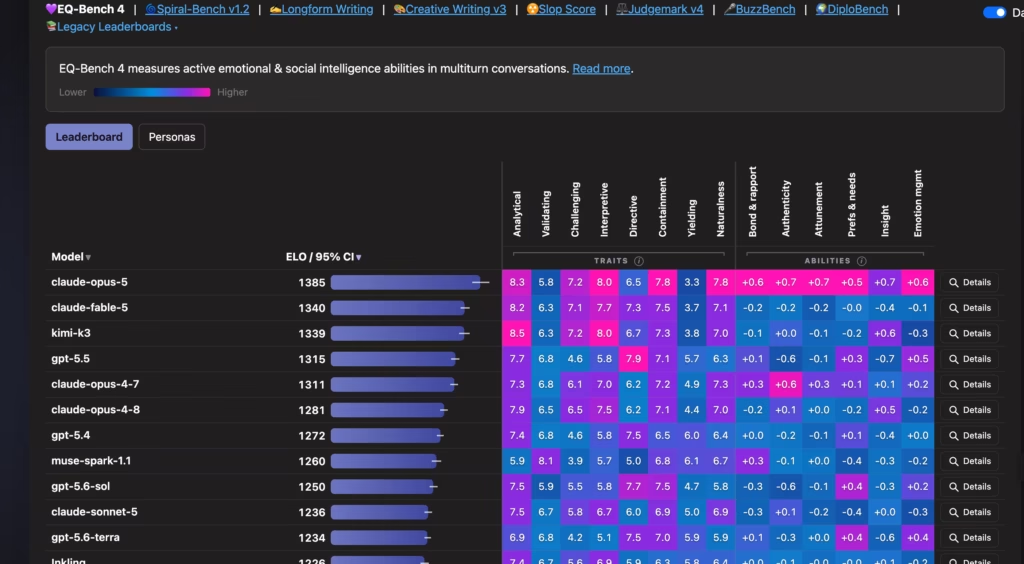
On the EQ-Bench Creative Writing benchmark and the LMArena creative writing leaderboard, Claude models have held the top positions throughout 2025 and 2026. The writing reads like a thoughtful human wrote it, not like an AI generated it.
Where Claude separates from ChatGPT: long-form coherence. A 3,000-word article drafted in Claude maintains consistent tone, logical structure, and argument progression from start to finish.
For blog posts, reports, proposals, essays, and any content over 1,500 words, Claude delivers the cleanest first draft.
Claude’s Artifacts feature lets you draft documents in a side panel while chatting about edits in the main window. That separation between “the document” and “the conversation about the document” matches how professional writers actually work.
The limitation: Claude is conservative. It hedges more than ChatGPT and sometimes refuses creative requests that push boundaries. For provocative marketing copy or edgy creative work, ChatGPT gives you more range.
Best for: Long-form content, essays, proposals, nuanced writing that needs to sound human.
Starting Price: $20/month
2. ChatGPT: Most Versatile All-Purpose Assistant
ChatGPT remains the Swiss Army knife. It handles writing, coding, image generation, web browsing, data analysis, and voice conversation in one interface.
For writing specifically, GPT-5 produces strong first drafts across every format: emails, social posts, ad copy, scripts, blog outlines, and creative fiction.
Where ChatGPT beats Claude: speed of iteration and breadth of capability.
You can draft an email, generate the header image, research a competitor, and build a spreadsheet without leaving the app. That workflow breadth is why ChatGPT has 400+ million weekly users. No other tool matches the range.
For writing quality specifically, ChatGPT produces slightly more formulaic output than Claude on long-form content. The “ChatGPT voice” (overly structured, heavy on transition phrases like “moreover” and “it’s worth noting”) is detectable to experienced readers.
But for short-form content (emails, social posts, product descriptions, ad copy), the quality gap is negligible.
Best for: Writers who need one tool for everything. Short-form content. Brainstorming.
Starting Price: $20/month
3. Google Gemini: Best for Research-Backed Writing
Gemini integrates with Google Search, Google Docs, Gmail, Drive, and the entire Google Workspace ecosystem.
For writing that requires current facts, cited sources, and real-time information, Gemini searches the web natively on every query and grounds its responses in search results.
Where Gemini beats both Claude and ChatGPT: research-heavy writing. If you are drafting an article that needs current statistics, recent news, or competitive intelligence, Gemini pulls live data into the draft without you having to search separately.
For journalists, analysts, and researchers who write from sources (not from imagination), that integration saves 30 to 45 minutes per article.
The prose quality is below Claude and roughly on par with ChatGPT. Gemini’s writing tends toward informational rather than stylistic. It tells you what happened. It does not make you feel it.
Best for: Research-backed writing, Google Workspace users, writers who need current data in their drafts.
Starting Price: $20/month
Marketing and Brand Writing Assistants
These tools generate marketing content at scale while maintaining brand voice consistency.
4. Jasper: Best for Marketing Teams Needing Brand Voice
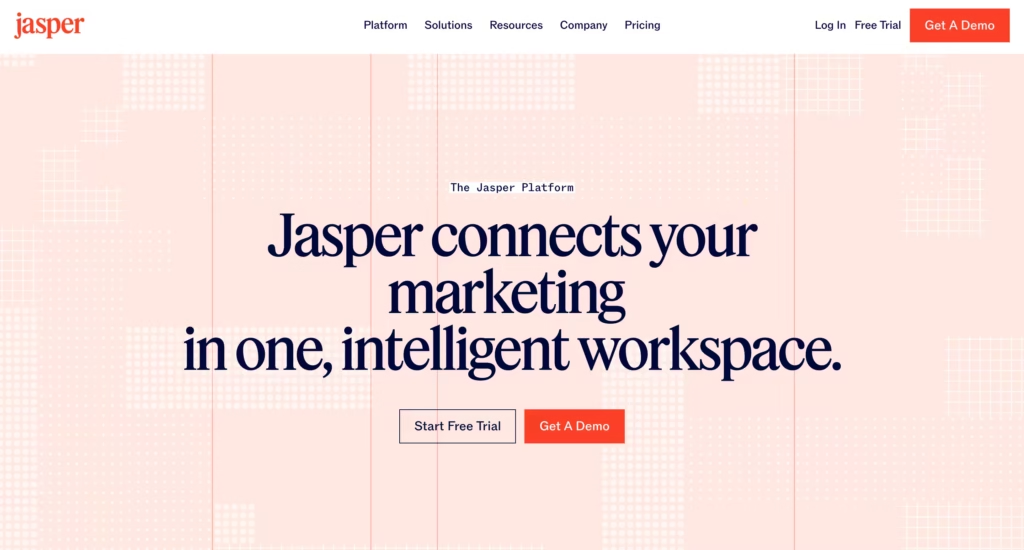
Jasper is the marketing team’s AI writing assistant. Its Brand Voice feature lets you upload examples (website copy, past emails, tone guidelines), and Jasper extracts a voice profile that every generated output follows.
For agencies managing 3 to 5 client voices or in-house teams that need 10 writers sounding like one brand, that consistency layer is the entire value proposition.
Jasper also includes campaign workflows where one brief generates coordinated content across email, social, web, and ad formats. For a product launch that needs 20 assets in the same voice by Friday, Jasper produces them faster than any general-purpose tool.
The honest assessment: Jasper’s underlying AI is not better than ChatGPT or Claude at raw writing quality. What you are paying for is the brand voice guardrails, the templates, the team collaboration, and the campaign workflow.
If you do not need those, Jasper at $59/month is an expensive ChatGPT wrapper.
Best for: Marketing teams, agencies, brand-consistent content at scale.
Starting Price: $59/month.
5. Copy.ai: Best for Short-Form Marketing Copy
Copy.ai specializes in the writing that marketers produce the most: ad headlines, email subject lines, product descriptions, social media captions, and landing page copy.
The platform generates multiple variations quickly (10 headline options in 15 seconds) so you can A/B test without writing each variation manually.
Copy.ai also includes workflow automation: connect it to your CRM, trigger content generation from events (new lead → personalized outreach email), and publish directly to connected platforms.
For sales teams that send high volumes of personalized outreach, the automation layer adds value that pure writing tools lack.
The limitation: Copy.ai produces functional copy, not memorable copy. It nails the structure and format. It does not produce the surprising word choice or fresh metaphor that makes great copywriting great. Expect to edit for voice and originality.
Best for: High-volume short-form marketing copy and automated outreach.
Starting Price: $29/month.
Editing and Polish Assistants
6. Grammarly: Best for Fixing What You Already Wrote
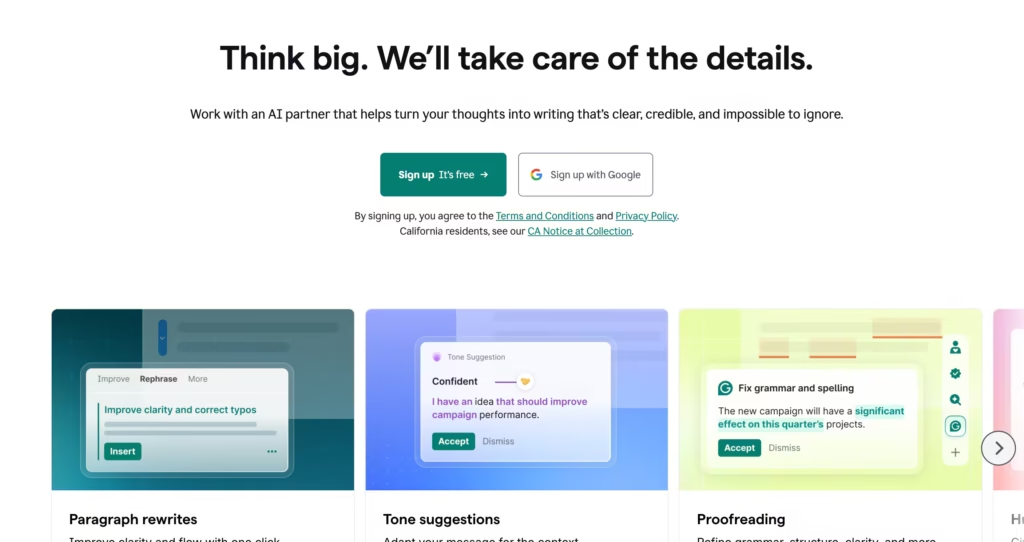
Grammarly is not a writing tool. It is an editing tool.
That distinction matters because many people buy Grammarly expecting content generation and are disappointed.
Grammarly catches grammar errors, tone mismatches, wordiness, passive voice overuse, and readability issues across every app on your computer.
Its AI detector (ranked #1 on the RAID benchmark) checks whether text was AI-generated. Its tone detection tells you how your writing will land before you hit send.
Grammarly works everywhere: browser, desktop apps, mobile keyboard, Google Docs, Slack, Gmail, Notion, LinkedIn, and over a million other integrations.
That ubiquity is its real competitive advantage. Claude and ChatGPT require you to go to them. Grammarly comes to you.
For a deeper breakdown of every feature, see our Grammarly AI features review.
Best for: Writers who draft manually (or with another AI) and want inline editing everywhere.
Starting Price: $12/month
Specialized AI Writing Assistants
7. Sudowrite: Best for Fiction Writers
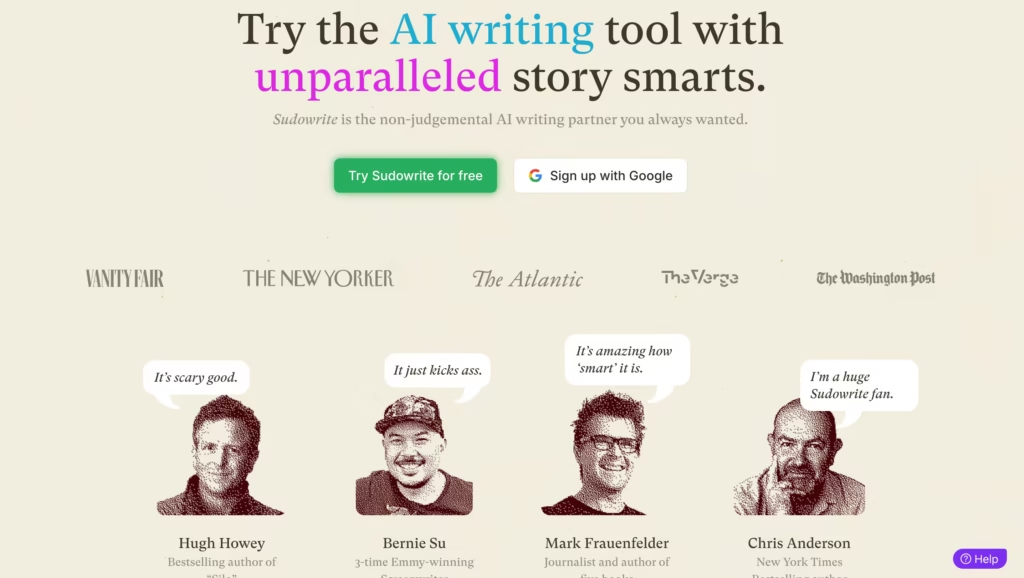
Sudowrite is built exclusively for fiction. Its proprietary Muse model is trained on published narrative prose, and the output reads like a novel, not like a blog post.
Story Bible maintains character consistency across chapters. Canvas maps plot structure visually. Describe, Expand, and Rewrite tools work at the sentence level.
For fiction writers, Sudowrite’s prose quality is noticeably better than ChatGPT or Claude on narrative voice, dialogue, and sensory detail. For everything else (emails, marketing, business writing), it is the wrong tool entirely.
For alternatives, see our Sudowrite alternatives review.
Best for: Novelists, short story writers, creative fiction.
Starting Price: $19/month.
8. Writesonic: Best Budget Option for SEO Blog Content
Writesonic focuses on SEO-optimized blog content.
It integrates with Surfer SEO for real-time optimization scores, suggests keywords, and structures articles around search intent. At $79/month for the basic plan, it is the cheapest dedicated content tool on this list.
The output quality requires more editing than Claude or ChatGPT. Writesonic’s drafts tend toward generic phrasing and need a human pass for voice, accuracy, and originality.
But for content teams producing 10+ blog posts per month where SEO structure matters more than literary quality, Writesonic gets you from outline to publishable draft faster than a blank page.
Best for: SEO content teams producing high-volume blog posts on a budget.
Starting Price: $79/month.
9. Notion AI: Best for Writers Who Live in Notion
Notion AI adds writing assistance inside the Notion workspace. Summarize a long document, generate action items from meeting notes, rewrite a paragraph in a different tone, or ask questions about your own notes.
The AI knows your workspace, which means it can reference information from other pages when helping you write.
Notion AI is not a standalone writing tool. It is an AI layer on top of a productivity platform.
If you already use Notion for project management, knowledge bases, and documentation, the $10/month add-on is worthwhile because everything stays in one place. If you do not use Notion, there is no reason to start just for the AI.
Best for: Notion users who want AI writing assistance inside their existing workspace.
Starting Price: $10/user/month.
10. QuillBot: Best for Paraphrasing and Academic Rewriting
QuillBot specializes in rewriting existing text.
You paste a paragraph, select a mode (Standard, Fluency, Formal, Creative, Academic), and QuillBot rephrases it while preserving the meaning. It also includes a grammar checker, plagiarism checker, summarizer, and citation generator.
For students writing research papers who need to paraphrase sources without plagiarizing, QuillBot is the most targeted tool available. It does not generate original content. It rewrites content you already have.
Best for: Students, academics, and anyone who needs to paraphrase existing text.
Starting Price: $4.17/month.
How Do These AI Writing Assistants Compare?
| Tool | Best for | Prose quality | Content generation | Editing | Brand voice | Starting price |
| Claude | Long-form, nuanced writing | Highest | Strong | Basic | No | $20/mo |
| ChatGPT | Versatility, short-form | High | Strong | Basic | No | $20/mo |
| Gemini | Research-backed writing | Moderate | Strong | Basic | No | $20/mo |
| Jasper | Marketing team content | Moderate | Strong | Basic | Yes (Brand Voice) | $59/mo |
| Copy.ai | Short-form marketing copy | Moderate | Strong (short-form) | No | Yes | $29/mo |
| Grammarly | Editing across all apps | N/A (editor) | Limited | Best in class | No | $12/mo |
| Sudowrite | Fiction writing | Highest (fiction) | Strong (fiction only) | Yes (Rewrite) | No | $19/mo |
| Writesonic | SEO blog content | Low-moderate | Strong | Basic | Limited | $79/mo |
| Notion AI | Notion workspace users | Moderate | Moderate | Moderate | No | $10/mo add-on |
| QuillBot | Paraphrasing, academic | N/A (rewriter) | No | Paraphrasing | No | $4.17/mo |
The Best Combinations by Writer Type
No single tool covers everything. Here are the combinations that work:
| Writer type | Best combination | Monthly cost |
| Freelance content writer | Claude (drafting) + Grammarly Pro (editing) | $32/month |
| Marketing professional | Jasper (brand content) + Grammarly Pro (polish) | $71/month |
| Student or academic | QuillBot (paraphrasing) + Grammarly Free (editing) | ~$5/month |
| Fiction writer | Sudowrite (drafting) + Grammarly Pro (editing) | $31/month |
| SEO content team | Writesonic (SEO drafts) + Claude (quality pieces) + Grammarly (editing) | $111/month |
| Budget writer | ChatGPT Free + Grammarly Free | $0/month |
| Google Workspace team | Gemini Advanced + Grammarly Business | $32/member/month |
After 50,000+ words across all 10 tools, my personal stack is Claude for drafting, Grammarly for editing, and ChatGPT for quick tasks and brainstorming. That $40/month combination handles 95% of my writing needs.
I switch to Gemini when I need current data mid-draft and have not touched Jasper since Claude’s prose quality made brand voice templates feel unnecessary for solo work.
FAQs
1) What is the best free AI writing assistant?
ChatGPT’s free tier (GPT-4o with usage limits) is the most capable free option for general writing. Grammarly Free catches grammar and spelling errors across all apps. QuillBot Free handles basic paraphrasing. Combined, ChatGPT Free + Grammarly Free costs $0 and covers most writing needs.
2) Is Claude better than ChatGPT for writing?
For prose quality and long-form coherence, yes. Claude produces more natural, less formulaic writing, especially on content over 1,500 words. For versatility (images, browsing, coding, voice), ChatGPT wins. For short-form content like emails and social posts, the quality gap is minimal.
3) Do I need Jasper if I already use ChatGPT or Claude?
Only if you manage multiple brand voices across a team. Jasper’s value is brand voice training and campaign-level content coordination. If you are a solo writer or a small team with one voice, ChatGPT or Claude handle the writing equally well at a fraction of the cost.
4) Can AI writing assistants write entire articles?
They can generate complete first drafts. They cannot produce publish-ready content without human editing. AI drafts consistently need fact-checking, voice adjustment, original insight, and structural refinement. The best workflow: AI generates 80% of the draft. You add the 20% that makes it genuinely yours.
5) Will Google penalize AI-written content?
Google penalizes low-quality content regardless of how it was created. AI content that adds genuine value, original analysis, and human expertise ranks well. Pure AI output with no human editing tends to rank poorly because it lacks the depth and originality that Google rewards.
