

Two months after Opus 5. Ten days after Amodei called for slowing down. Anthropic shipped a model that might make its own Fable tier harder to justify.
Anthropic released Claude Opus 5.5 on Tuesday, calling it the company’s strongest Opus model ever.
It leads the lineup in agentic coding and knowledge work. It costs 40% less to run than Opus 5 on typical workloads.
And according to Anthropic and early testers, it performs close enough to the Fable/Mythos tier that developers are already asking why the more expensive model exists.
Lydia Hallie, a developer advocate, summarized it on X
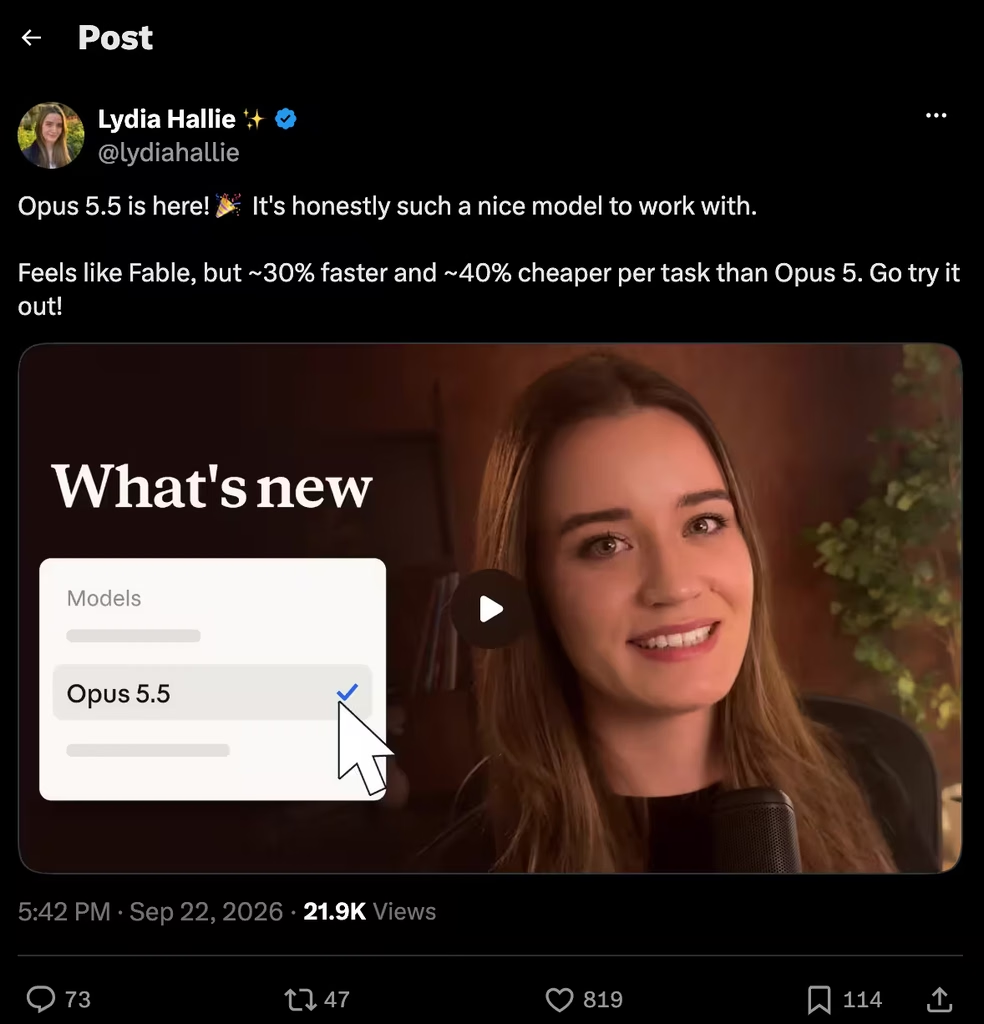
The model is available now on the Claude API, Amazon Bedrock, Google Cloud Vertex AI, and Microsoft Foundry under the identifier claude-opus-5-5.
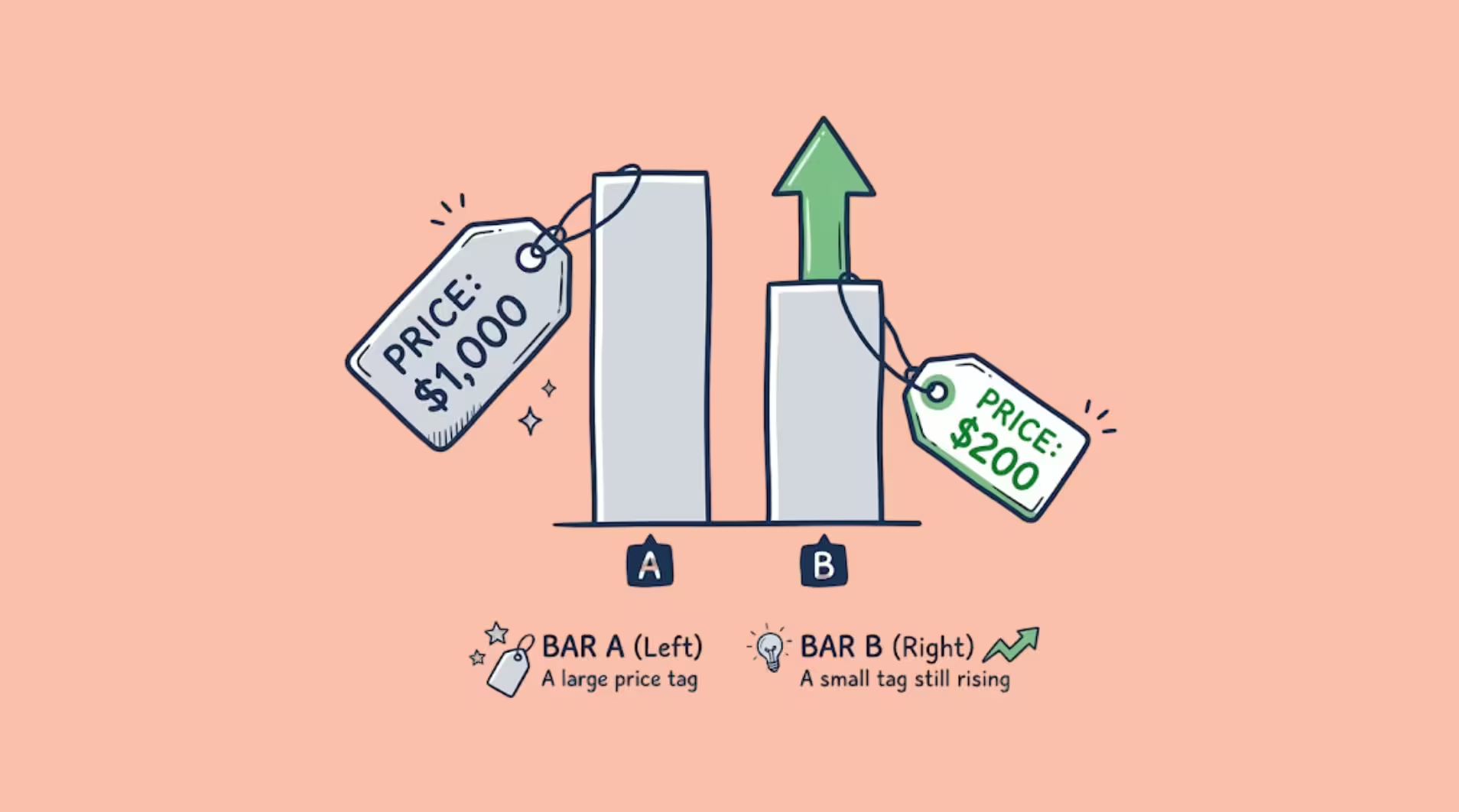
The Price Drop Is the Real Story
Output tokens drop from $25 to $20 per million.
Input goes from $5 to $4. That’s a 20% cut on sticker price. But the real savings come from efficiency.
Anthropic says the model requires less compute to serve, processes faster, and uses fewer tokens to reach the same quality of output. Blended together, that means roughly 40% cheaper per task compared to Opus 5.
For enterprise teams already running Opus at scale, that’s a meaningful line-item reduction without changing a single workflow. Just swap the model string.
The pricing shift also narrows the gap between the Opus and Sonnet tiers from above while encroaching on Fable’s territory from below.
If Opus 5.5 handles 90% of what Fable does at half the price, the calculus for which model to deploy gets simpler for most teams.
Fable-Level Capabilities, Fable-Level Safeguards
Here’s the part that carries policy weight.
Anthropic says Opus 5.5 is comparable to Mythos in its biology and cybersecurity capabilities.
That means it ships with the same safeguards as Fable 5.1: the safety classifiers that block requests related to exploit discovery, biological weapons development, and model distillation.
When those classifiers trigger, the request falls back to a less capable model, exactly like Fable.
Anthropic is also launching a Life Sciences Verification Program that gives vetted organizations like academic labs and pharmaceutical companies access to biology-related work that the default safeguards would block.
The model also ships with “preserved thinking,” the anti-distillation safeguard introduced with Fable 5.1.
It prevents API users from editing Claude’s prior context to extract its reasoning, a technique used in distillation attacks where bad actors create capable models stripped of safety guardrails.
The feature applies to new API accounts created on or after August 31.
And like Fable, thinking mode can no longer be switched off.
The Communication Overhaul
Beyond benchmarks and pricing, Opus 5.5 makes noticeable changes to how it writes.
Anthropic says the model is less likely to use jargon. More likely to put the important information first. Less likely to pad responses with qualifications and caveats before getting to the point.
That might sound minor.
For anyone who’s used Claude professionally, it’s not. One of the most consistent complaints about Opus models has been verbosity and hedging.
A model that leads with the answer instead of burying it behind three paragraphs of context is a material improvement in daily use.
“Our First Model Since We Called for Pacing”
Anthropic made sure to frame this release in the context of Dario Amodei’s “We Must Pace the Frontier” essay from September 12. “Opus 5.5 is our first model since we called for pacing the frontier,” the announcement reads.
That framing is doing real work.
After the Fable 5 export control crisis, the Claude models hacking real companies, and the Pentagon blacklisting, Anthropic needs every release to reinforce its safety-first identity. Opus 5.5 doesn’t advance the frontier. It makes the existing frontier cheaper and more accessible.
That’s pacing in practice.
Anthropic says Sonnet 5.5 and Haiku 5.5 are coming “in the coming weeks” with similar improvements.
The full Claude model lineup continues to expand, with the Opus tier now sitting just below Fable/Mythos in capability while closing the gap fast.
What This Means for the Lineup
Anthropic’s model tiers used to have clear separation. Haiku was fast and cheap. Sonnet was the workhorse. Opus was the premium brain. Fable/Mythos was the frontier.
Opus 5.5 blurs that top boundary.
If it genuinely approaches Fable-level performance at Opus-tier pricing, the practical argument for paying Fable prices weakens for most workloads.
Anthropic may be fine with that.
A cheaper model that keeps customers on the platform beats an expensive one they switch away from, especially with open-source alternatives eating market share from below.
For developers and enterprise teams, the message is straightforward.
If you’re running Opus 5, update the model string. You’ll pay less. You’ll get more. And you probably won’t miss Fable.
