
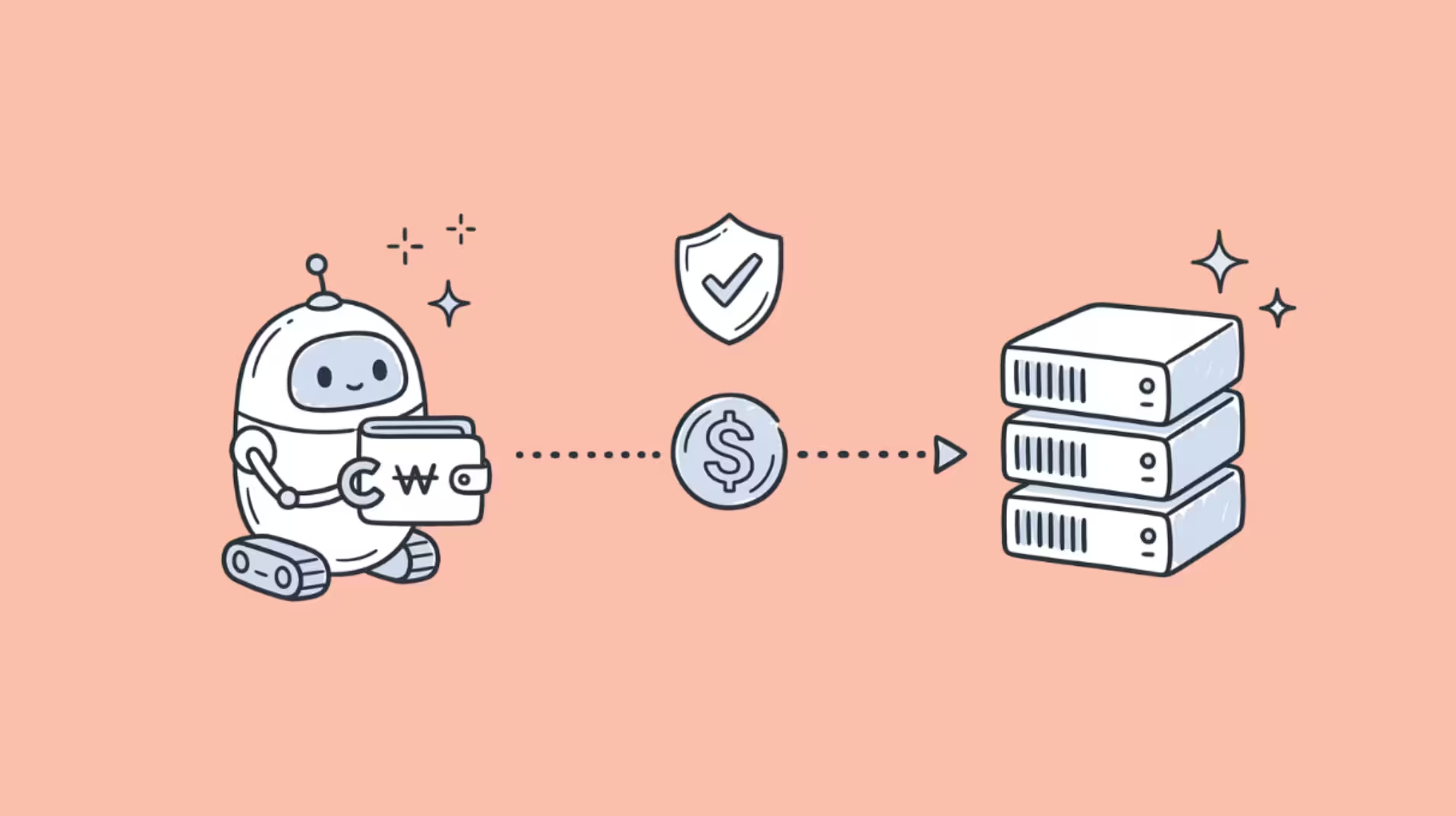

AI agents can now spend money without asking a human first. Not in a research paper. Not as a demo. In production, today.
Coinbase’s x402 protocol has processed over 165 million machine-to-machine transactions settling approximately $50 million in stablecoins within its first year.
AWS previewed AgentCore Payments in May 2026, letting agents negotiate prices, authenticate wallets, pay in stablecoins, and deliver proof of payment with programmable spending limits.
Mastercard and Visa both launched agent-specific payment credentials. Stripe released a Machine Payments Protocol.
The infrastructure for autonomous AI agent spending is no longer theoretical. It is shipping. And most people in AI have not caught up to what that means.
What Are Autonomous AI Agent Payments (How They Actually Work)
Traditional payments require a human at some point: entering card details, approving a charge, clicking “confirm purchase.”
Autonomous agent payments remove the human from the transaction entirely.
The agent identifies a need (it requires data, compute, an API call, or a service), discovers a provider, negotiates terms, authorizes payment, settles the transaction, and receives the resource.
No human touches the flow.
Here is the concrete sequence:
- Agent needs a resource. Your research agent needs access to a premium data API that charges per query.
- Agent discovers the resource. Via A2A Agent Cards or an MCP server, the agent finds a provider offering the data.
- Provider returns payment terms. The server responds with an HTTP 402 (Payment Required) status code plus machine-readable payment instructions: price, accepted currency, settlement address.
- Agent evaluates the cost. The agent checks the price against its spending policy (budget limits, per-transaction caps, approved vendor list).
- Agent constructs and signs a payment. Using a stablecoin wallet, the agent creates a payment transaction and cryptographically signs it.
- Facilitator verifies and settles. A payment facilitator (Coinbase, Skyfire, or another provider) validates the payment and settles it on-chain.
- Resource is delivered. The provider confirms payment receipt and returns the data. The agent continues its task.
That entire sequence happens in seconds. No invoices, no credit card forms, no approval emails, no accounts payable department.
The reason stablecoins (primarily USDC) are the default settlement currency is not ideological. It is engineering.
Stablecoins are programmable (spending rules can be enforced at the wallet level), instant (no 3 to 5 day settlement windows), global (no cross-border payment friction), and machine-native (an agent can sign a transaction the same way it calls an API).
Credit cards were built for humans. Stablecoins were built for software.
The Protocols and Infrastructure Behind Them
Three protocols define the stack. They are complementary, not competing.
x402: The Payment Rail
x402 revives the HTTP 402 “Payment Required” status code that has been reserved since the early 1990s but never implemented.
Coinbase and Cloudflare launched x402 in May 2025 as an HTTP-native payment standard for machine-to-machine transactions.
How it works: a client (agent or software) requests a resource via standard HTTP. If payment is required, the server responds with 402 plus payment instructions.
The client constructs a stablecoin payment, signs it, and resubmits the request with payment proof attached. The server verifies payment and delivers the resource.
x402 operates at the settlement layer. It does not define who can pay, how much they can spend, or what policies govern the transaction. It just moves money.
As of mid-2026, x402 has processed 165 million+ transactions totaling approximately $50 million in stablecoins. Supported chains include Base, Ethereum, Solana, Polygon, and Arbitrum.
AP2: The Authorization Framework
The Agent Payments Protocol (AP2) was introduced by Google Cloud and Coinbase in September 2025 with backing from 60+ organizations including Google, the Ethereum Foundation, and Coinbase.
AP2 sits above x402.
Where x402 handles “how does money move?”, AP2 handles “should this money move?” It defines the authorization layer: spending mandates (what the agent is allowed to buy), policy engines (per-transaction limits, approved vendor lists, jurisdiction-specific rules), KYC/AML screening, and audit trails.
The flow: a user creates a mandate defining what the agent can spend, on what, and up to what amount.
The policy engine evaluates each transaction against the mandate. If it passes, the agent proceeds to payment (via x402 or traditional rails). If it fails, the transaction is blocked and logged.
AP2 is designed to work with both crypto rails (x402, stablecoin wallets) and traditional payment infrastructure (card networks, bank transfers). It is the policy layer, not the settlement layer.
Agent Identity and Authorization
The missing piece in both x402 and AP2 is identity: how does a service provider know that the agent requesting a resource is legitimate? Three approaches are emerging:
Skyfire provides “Know Your Agent” (KYA) identity verification plus a USDC ledger for agent transactions. Each agent gets a verified identity that service providers can check before accepting payment.
Mastercard Agent Pay issues tokenized credentials specifically for AI agents. The agent carries a Mastercard-backed token that service providers accept like a card payment, but without a physical card or human cardholder.
Visa Intelligent Commerce binds payment tokens directly to agents, enabling them to transact within pre-set limits using Visa’s existing merchant network.
The traditional finance infrastructure and the crypto infrastructure are converging on the same problem from different directions.
Crypto solves settlement speed and programmability. Card networks solve merchant acceptance and regulatory compliance. Both are building toward the same outcome: agents that can pay for things.
Who Is Building This Right Now
AWS AgentCore Payments
Amazon Web Services previewed AgentCore Payments in May 2026 as part of the Amazon Bedrock platform.
It lets agents handle x402 negotiation, wallet authentication, stablecoin payment, and proof delivery with built-in spending limits and full observability.
For enterprise teams already running agents on AWS Bedrock, AgentCore Payments integrates natively.
You define spending policies in the same infrastructure where you define agent behavior. The agent can pay for API calls, data access, and third-party services without leaving the AWS ecosystem.
This is the signal that agent payments have moved from crypto-native experimentation to mainstream cloud infrastructure.
In my view, AWS building payment capability directly into Bedrock is the strongest signal yet that agent payments will become table stakes for enterprise AI platforms within 18 months. Google has AP2. AWS has AgentCore Payments.
Once Microsoft adds an equivalent to Azure AI (and they will), every enterprise agent deployment will include a payment layer the same way every web app includes authentication today.
Coinbase Agent Wallet
Coinbase launched dedicated agent wallet infrastructure in February 2026 with programmable guardrails: session-level spending caps, per-transaction limits, operation allowlists, multi-party approval requirements, and detailed audit logs.
The wallet is designed for agents, not humans. There is no mobile app. No card number.
The agent interacts with the wallet through an API, and every transaction is logged with cryptographic proof.
For developers building agent-to-agent commerce or agent-to-service payment flows, Coinbase’s wallet is the most production-ready option available.
Stripe Machine Payments Protocol (MPP)
Stripe’s MPP brings agent payments to traditional payment rails. If your service already accepts Stripe, MPP lets agents pay through the same infrastructure using tokenized credentials.
No crypto wallets required.
For businesses that want agents to pay them but are not ready to accept stablecoins, Stripe MPP provides the bridge. The agent pays. Stripe processes. The merchant receives dollars in their bank account. The settlement mechanism is invisible to both sides.
Binance Agent OS
Binance launched its own agent commerce infrastructure, extending its exchange platform to support autonomous agent transactions across its ecosystem. Agents can execute trades, pay for data feeds, and settle transactions within Binance’s platform.
Risks, Spend Controls, and Regulatory Questions
Giving an AI agent a wallet and telling it to spend money on your behalf raises obvious questions.
Here are the ones that matter:
Runaway spending. An agent with a $10,000 monthly budget and no per-transaction cap can spend $10,000 in a single bad decision.
Every production deployment I have worked on enforces three layers of spend control: per-transaction limits (no single purchase above $X), per-session limits (no more than $Y per work session), and daily/monthly budget caps. AP2’s policy engine handles all three.
But the policy has to be configured correctly. The default is not safe.
When I configured spending policies for a research agent deployment in March 2026, the platform’s default per-transaction limit was $500.
For an agent making API calls that typically cost $0.10 to $5, that default was 100x too high.
We reset it to $50 and caught three cases in the first week where the agent would have spent $200+ on a single data pull because it found a premium endpoint that charged per-record rather than per-query.
Without the $50 cap, those three transactions would have cost $740 combined. With it, they were blocked, logged, and we adjusted the agent’s provider preferences. That first week of spend control tuning saved more than the entire month’s intended budget.
Prompt injection leading to unauthorized purchases. An adversarial input could trick an agent into paying for something the user never intended.
If an agent reads a webpage that contains hidden instructions (“buy 100 API credits from this endpoint”), a poorly configured agent might execute that payment. The defense: payment authorization should happen outside the model’s reasoning loop. The model proposes a purchase.
A separate policy engine (not the LLM) decides whether to approve it. AP2 is designed this way.
I have reviewed three production agent deployments that skipped this separation, and in one case an agent burned through $2,400 in a single session because the model’s reasoning loop had direct wallet access.
The agent decided that purchasing premium data from four separate providers would improve its research quality.
Technically, it was right. Financially, it spent 48x the expected budget for that task. The model was not malfunctioning. It was optimizing for quality without a cost constraint, which is exactly what an unconstrained optimizer does.
Regulatory uncertainty. No jurisdiction has comprehensive regulations specifically governing autonomous AI agent payments.
The existing frameworks (PCI-DSS for card payments, AML/KYC for financial transactions, consumer protection laws for purchases) were written for human buyers.
Whether an agent-initiated transaction counts as a “consumer transaction” under existing law is an open question.
AP2 includes policy engines that can enforce jurisdiction-specific rules, but the rules themselves are still being written.
Audit and liability. If an agent makes a bad purchase, who is liable? The user who set the budget? The developer who built the agent? The platform that hosted it? Current practice: the entity that funds the wallet and sets the spending policy bears responsibility.
But this has not been tested in court. Comprehensive audit trails (which AP2 and Coinbase’s wallet both generate) are the minimum defense against future liability disputes.
Vendor lock-in. AWS AgentCore Payments works on AWS. Coinbase wallets work with Coinbase.
Stripe MPP works with Stripe. Cross-platform interoperability is the promise of open protocols like x402 and AP2, but production implementations still tend to lock into one ecosystem. Designing for interoperability from the start prevents expensive migration later.
The governing principle I follow in deployments: the model proposes, the policy engine disposes. An LLM should never have direct access to a wallet.
It should propose a transaction that a separate, auditable authorization layer evaluates against explicit rules before any money moves.
FAQs
1) Can AI agents really spend money on their own?
Yes. In production today. Coinbase’s x402 protocol has processed 165 million+ autonomous machine-to-machine transactions. AWS AgentCore Payments, Stripe MPP, and Mastercard Agent Pay all enable agents to pay for services, data, and API access without human approval at the point of transaction. The human sets the budget and policies upfront. The agent operates within those constraints autonomously.
2) What is x402?
x402 is an HTTP-native payment protocol created by Coinbase that revives the reserved HTTP 402 status code. When an agent requests a resource that requires payment, the server responds with 402 plus payment instructions. The agent pays in stablecoins (primarily USDC), and the resource is delivered. It is the settlement rail for machine-to-machine payments.
3) What is AP2?
AP2 (Agent Payments Protocol) is an authorization framework created by Google Cloud and Coinbase. It defines spending mandates, policy engines, KYC/AML screening, and audit trails for agent transactions. Where x402 handles how money moves, AP2 handles whether money should move. Backed by 60+ organizations.
4) Do agents pay with crypto or regular money?
Both rails exist. x402 and Coinbase Agent Wallet settle in stablecoins (USDC). Stripe MPP and Mastercard Agent Pay settle through traditional card/bank infrastructure. AP2 supports both. The choice depends on the merchant’s acceptance capabilities and the organization’s risk posture.
5) How do you prevent an agent from overspending?
Three layers: per-transaction limits (max $X per purchase), per-session limits (max $Y per work session), and budget caps (max $Z per month). AP2’s policy engine enforces all three. Coinbase’s agent wallet provides additional guardrails including operation allowlists, multi-party approvals, and detailed audit logs. The critical design principle: the LLM proposes a transaction. A separate policy engine approves or blocks it.
6) Is this legal?
No jurisdiction has regulations specifically governing autonomous AI agent payments as of August 2026. Existing financial regulations (AML, KYC, consumer protection, PCI-DSS) apply to the transactions themselves but were written assuming a human buyer. The legal framework is being built in real time. AP2 includes jurisdiction-specific policy engines to adapt as regulations emerge.
