
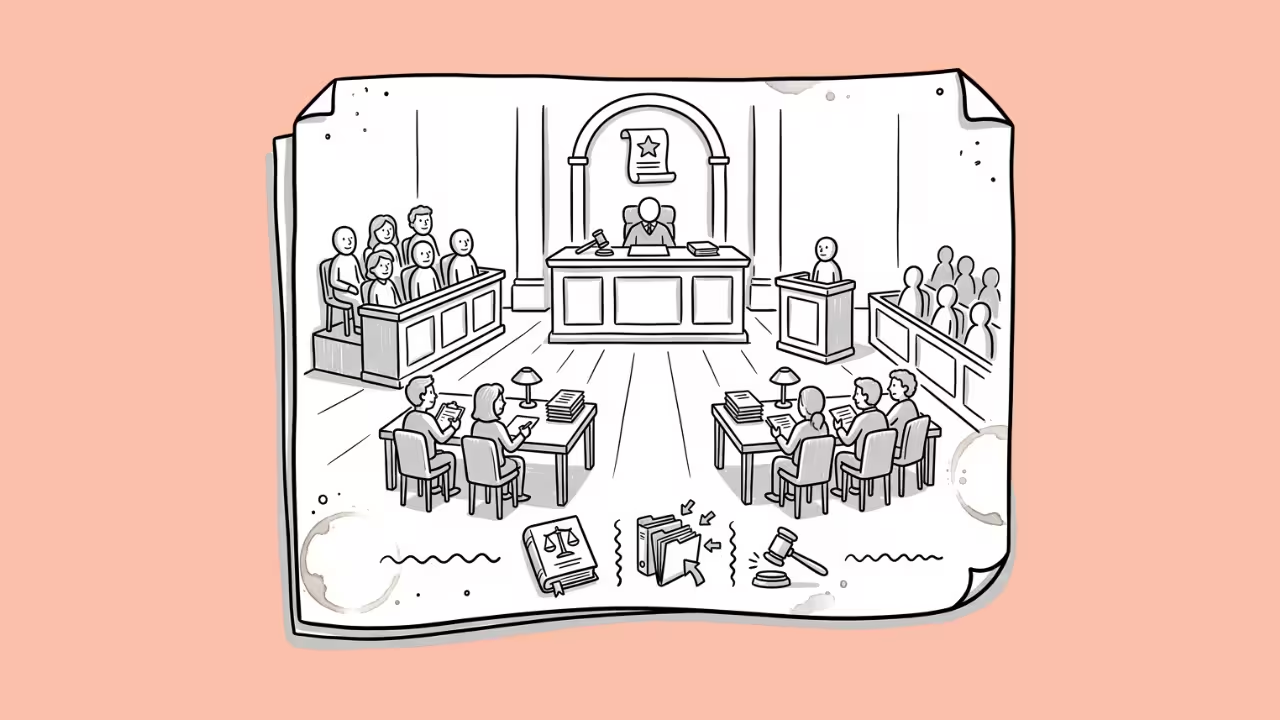

A federal judge just handed Anthropic a win on Thursday evening.
U.S. District Judge Rita Lin ruled that the Trump administration broke the law when it labeled the AI company a “supply-chain risk.”
The decision is the first major court victory for Anthropic in its ongoing battle with the Pentagon.
This fight has been brewing for months. Now, it has reached a turning point.
The Ruling
Judge Lin said Defense Secretary Pete Hegseth’s decision to tag Anthropic as a national security threat was “unlawful retaliation.” That violates the First Amendment.
She also called the move “arbitrary and capricious.” On top of that, she said Anthropic never got the due process it deserved under the Fifth Amendment.
That is a serious legal problem for the government. In her ruling, Lin pointed to something telling. She wrote that the government’s own actions gave away its true motive.
According to Lin, officials wanted to “make a public example” out of Anthropic because the company pushed back against them.
The Origin
It all traces back to Anthropic’s safety rules. Earlier this year, the company refused to let the Pentagon use its AI models for fully autonomous weapons.
It also blocked any use of its models for mass surveillance of American citizens. The Pentagon did not take kindly to those limits.
Officials claimed they only wanted to use the models for lawful purposes. They also argued that Anthropic had no right to control how the military uses tech it paid for.
Then, in early 2026, Hegseth and President Trump escalated things by slapping Anthropic with a supply-chain risk label.
That order told every federal agency, not just defense ones, to stop working with the company entirely.

Contradictions
Judge Lin found the government’s story did not add up. And she explained exactly why. For starters, Hegseth had floated using the Defense Production Act on Anthropic.
That law is meant for companies considered essential to national security. You cannot call a company essential and dangerous at the same time. Lin caught that contradiction right away.
The Department of Defense kept trying to land a contract with Anthropic, even after the risk label. That is an odd move if the government truly believed the company posed a threat.
The government also teamed up with Anthropic’s newer model, Mythos, for cybersecurity work. Again, that partnership does not square with treating the company like a security risk.
Lin also shut down claims about hidden backdoors. She confirmed that Anthropic has no secret access to its own technology once it hands it over to the Department of Defense.
Judge Lin said the Department of War can absolutely pick whatever AI vendor it wants. Nobody is disputing that.
But officials cannot punish a company just for speaking up. National security cannot be used as an excuse to go after critics of the government.
Anthropic
Anthropic said it wants to keep working with the government in good faith. Its goal, according to the statement, is to help harness AI for national security in a way that benefits all Americans.
That message strikes a cooperative tone, even after months of tension. Anthropic seems eager to move past the conflict and refocus on partnership.
