
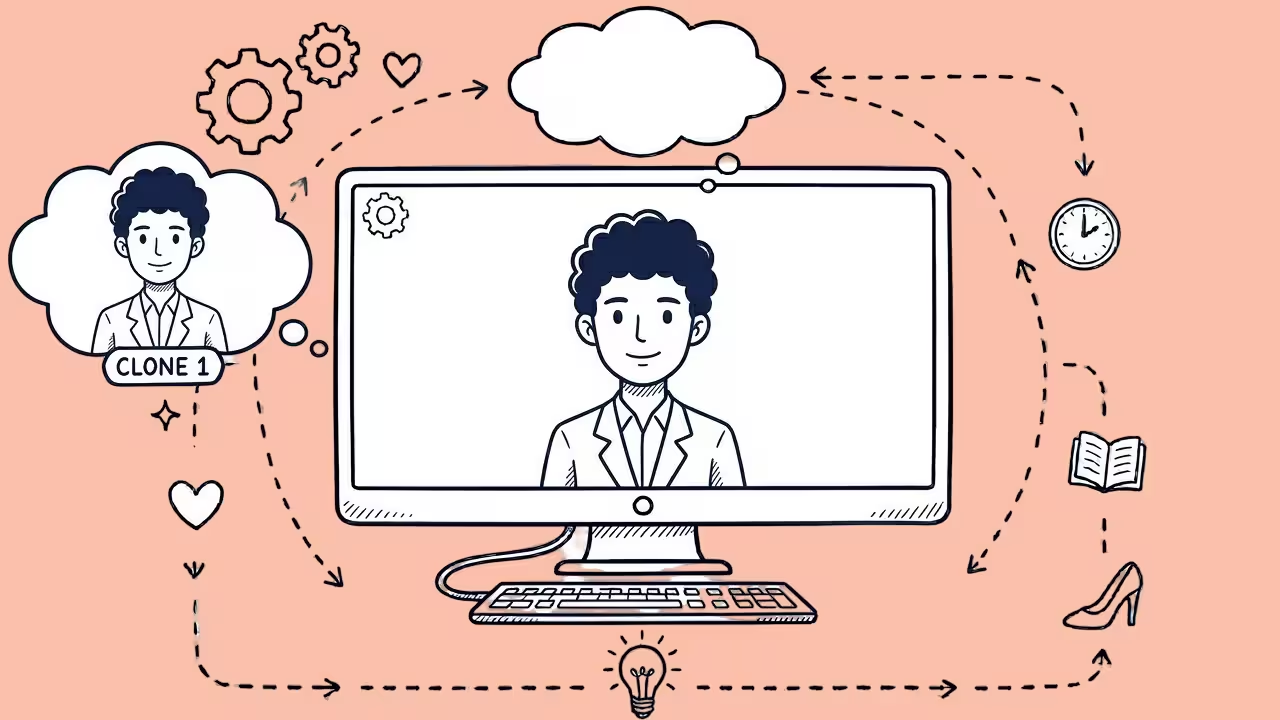

Imagine asking your CEO a question and getting an answer, instantly, without ever booking a meeting.
That’s the future Meta is reportedly building, and Mark Zuckerberg is the first test subject.
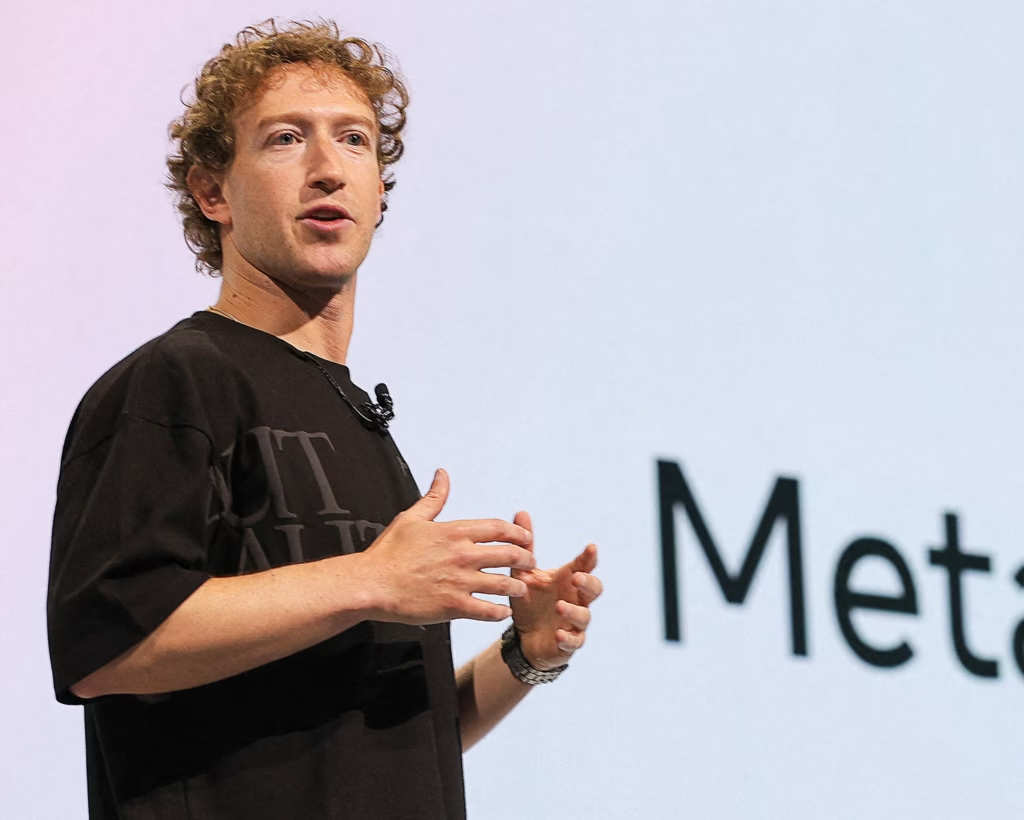
According to the Financial Times, Meta is developing an AI clone of Zuckerberg to help the company’s nearly 79,000 employees feel more connected to a Silicon Valley icon, even when he’s not in the room.
AI Clone
It’s like a chatbot, but one that sounds like Zuckerberg, looks like him, and talks the way he does.
The AI character is being trained on his public statements, his thoughts on company strategy, and his general tone and mannerisms.
It uses his actual voice and image, according to people familiar with the project who spoke to the FT. Zuckerberg himself is taking part in the training process.
In other words, Meta isn’t just building a generic assistant. They’re building a digital version of the CEO, one that can show up in your inbox, your workflow, or your screen at any time of day.
“When you add realistic AI video and voice, engagement and retention go up significantly.
People work better when the information they need is delivered by a familiar face or voice,” said a Synthesia spokesperson.
Synthesia, a UK-based AI video startup valued at $4 billion, says this kind of tech is no longer science fiction.
The company specializes in realistic video avatars and has seen firsthand how lifelike delivery changes the way people absorb information at work.
Digital Experiments
Zuckerberg has a history of experimenting with his own digital likeness. Back in 2022, he shared an avatar of himself inside his company’s metaverse platform.
The response was brutal as people mocked the graphics relentlessly online. He quickly posted an upgraded version.
But the damage was done, and the moment became a symbol of Meta’s stumbling metaverse ambitions. Since then, Meta has quietly scaled back its metaverse vision.
The company shifted focus toward something more practical: AI-generated 3D characters that can hold real conversations with people. The Zuckerberg AI project builds directly on that work.
Staff Meetings
Running a company with nearly 79,000 employees isn’t easy. There are only so many hours in a day and so many all-hands meetings you can hold.
In 2023, Zuckerberg held a company-wide session just two days after announcing 10,000 layoffs.
Employees, still rattled, peppered him with questions about job security and the future of remote work. It was high-stakes, high-pressure, and very human.
But the Wall Street Journal has reported that Zuckerberg also has a “CEO agent,” a personalized AI system designed to help him pull internal company information faster.
That tool is already in use, and the AI clone project goes one step further: it puts a version of him in front of employees, even when he can’t be there himself.
Avatar Influencers
Meta believes the Zuckerberg model could be replicated by influencers and content creators who want to scale their presence without being physically present 24/7.
That idea hits at something in the creator economy. Fans want access and creators want rest.
AI avatars could bridge that gap, offering a version of your favorite personality that never sleeps, never misses a DM, and always sounds just like the real thing.
It also raises big questions. How much of a person can you recreate digitally? Where does the real end and the AI begin?
And does the audience even care, or does it just matter that the content feels authentic?
Meta’s AI
The clone project is just one piece of a much bigger strategy. Zuckerberg is pushing Meta to use AI across its entire business, not just in its products, but in how the company operates internally.
The idea, he has said, is to flatten the organizational structure and get more done with fewer layers of management.
“We’re elevating individual contributors and flattening teams,” he said in January of this year.
Last week, Meta launched Muse Spark, an advanced AI model that can reportedly estimate calories in a meal from a photo.
It can also plan a family vacation, writing itineraries and researching activities simultaneously.
The model has drawn praise for language and visual tasks, though it lags in coding and abstract reasoning compared to some rivals.
The broader goal, according to Zuckerberg, is to eventually reach “superintelligence,” a system capable of outperforming humans on any cognitive task.
That’s an ambitious claim, and one shared by several competitors also pouring billions into AI research.
Legal Trouble
All of this innovation is happening against a difficult legal backdrop. Last month, a New Mexico jury ordered Meta to pay $375 million in civil penalties related to misleading consumers about platform safety.
A California court separately found that Meta deliberately designed Instagram to be addictive, and that a young user was harmed as a result.
Meanwhile, British Prime Minister Keir Starmer has called on platforms like Instagram and TikTok to tackle addictive features targeting young users.
The UK is actively exploring bans, curfews, and app time limits for users under 16.
“I think equally important, the addictive scrolling mechanisms are really problematic to my mind. They need to go,” Starmer told BBC Radio on Monday.
None of that has slowed Meta’s AI ambitions. If anything, the company seems to be doubling down, betting that the technology will solve as many problems as it creates.
