


When Sundar Pichai walked up to the podium at Stanford University last weekend, he probably expected applause. What he got instead was a chorus of boos and hundreds of empty seats.
About 200 graduating students walked out of the commencement ceremony. Others stayed, but made their feelings loud and clear.
It was an uncomfortable moment for one of the most powerful tech executives in the world.
The Walkout
Sundar Pichai earned his graduate degree at Stanford in materials science and engineering.
He was coming back as a success story, a living example of where ambition and hard work can lead.
Instead, he left as a symbol of something students say they want no part of. Signs in the crowd read “ICE SPIES WITH GOOGLE AI” and “GENOCIDE RUNS ON GOOGLE.”
Palestinian flags waved through the air, and chants of “Free Palestine” broke out across the venue.
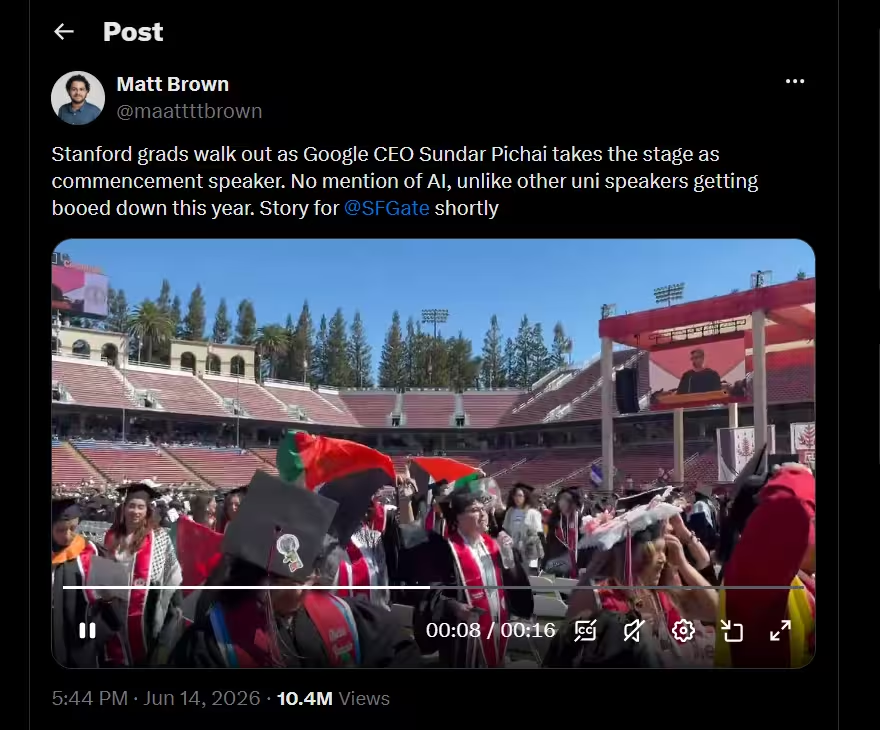
The walkout was coordinated by several campus groups, including Stanford Students for Justice in Palestine, No Tech for Apartheid, and Tech for Liberation.
“We are walking out because we refuse to glorify the corporations that fuel this violence,” a statement from organizers read.
The students said they were exercising their power to choose differently.
Also read: Google Joins OpenAI and xAI in Handing AI to the Pentagon
Project Nimbus
The target was Project Nimbus, a $1.2 billion contract that Google shares with Amazon. Under the deal, both companies provide cloud computing and AI services to the Israeli military.
The contract has been deeply controversial since it came to light. Critics argue that it directly supports military operations in Gaza.
Google has explained that the contract covers standard commercial services. But the backlash hasn’t gone away.
In 2024, Google fired 28 employees who staged internal protests against the deal. Even after those firings, dissent inside the company continued.
The Electronic Frontier Foundation, a prominent digital rights group, recently called out Google and Amazon for “choosing to look the other way” on how Israel uses their services.
Google’s Ties to ICE
Protesters also targeted Google’s relationship with U.S. Immigration and Customs Enforcement (ICE).
The agency has been at the center of intense national debate over immigration raids and deportation policies.
Critics say tech companies that provide services to ICE are enabling those operations.
For many students, these two issues, military AI contracts and immigration enforcement, represent the same core problem: Big Tech choosing profit over people.
Silicon Valley
Not everyone sympathized with the students.
Vinod Khosla, the billionaire co-founder of Sun Microsystems and one of Silicon Valley’s most prominent venture capitalists, fired off a sharp post on X. He called the protest “biased, idiotic, short-sighted, and very selfish.”
His specific argument was about scale. He said students were ignoring the potential of AI to help “the bottom 3 billion people on this planet,” while focused on what he described as “misinformed selfish self-interest.”
It was a sentiment echoed by others in the tech world. But critics of that view say it misses the point entirely.
Supporting vulnerable populations and opposing military AI contracts are not mutually exclusive positions.
Amazon
Amazon is also a partner on Project Nimbus. And Microsoft has faced its own wave of criticism for providing cloud services to the Israeli government.
Microsoft eventually responded to pressure. After an investigation found its cloud services were being used to mass-surveil Palestinians, the company tightened restrictions on how the Israeli government could use its technology.
But Google is yet to do the same.
Across the country in 2026, commencement speakers have been facing pushback when they try to sell graduating students on the promise of AI.
Students are skeptical; many worry that AI is threatening their job prospects. Others feel that the technology is being deployed in ways that harm society.
But this protest against Pichai wasn’t just generic AI skepticism. Students were angry about specific choices made by a specific company.
That kind of targeted, informed dissent is harder to dismiss.
